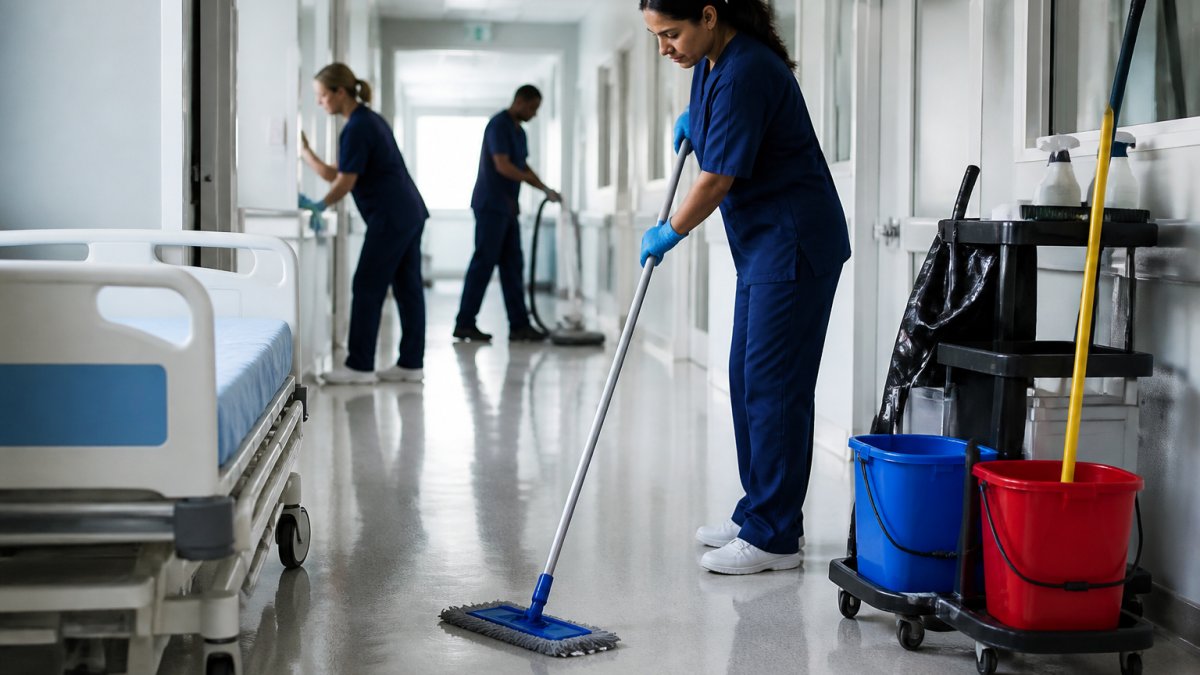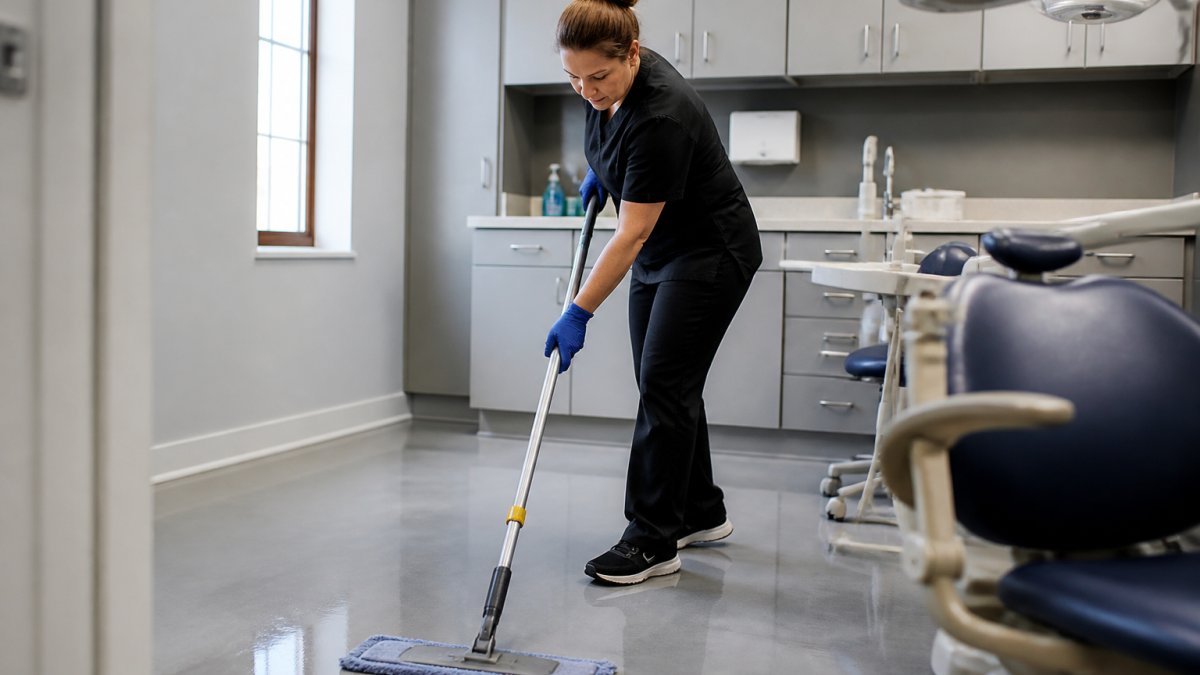

Table of Contents
- Is Outsourcing Medical Cleaning Worth the Cost? The Honest Answer
- In-House vs Outsourced Cleaning Services: What Each Model Really Costs
- Healthcare Facility Cleaning Checklist: What Medical Cleaning Must Cover
- Medical Cleaning Service Contract Checklist: Accountability in Writing
- Medical Office Deep Cleaning: A Line Item, Not an Upsell
- Where Outsourcing Wins and Where It Falls Short
- Conclusion: Running the Numbers on Medical Cleaning
- Frequently Asked Questions
Last Updated: October 12, 2026
Is Outsourcing Medical Cleaning Worth the Cost? The Honest Answer
Whether outsourcing medical cleaning is worth the cost depends on one thing most comparisons skip: whether you’re counting the full cost of an in-house crew or only the payroll line.
The honest answer: outsourcing usually wins on total cost of ownership for small and mid-size medical offices. Larger hospitals with dedicated environmental services departments often keep the work in-house. Below, we’ll show you how to run the numbers yourself.
Outsourcing medical cleaning is worth the cost when total cost of ownership, not the hourly rate, favors the vendor. Add wages, benefits, supplies, supervision, turnover, and infection-control risk before you compare quotes.
In-House vs Outsourced Cleaning Services: What Each Model Really Costs
In-house cleaning means you employ the cleaning staff directly. Outsourced cleaning means a janitorial services vendor employs them under a service agreement. The cost difference shows up in two places: what you see on the books, and what you don’t. Most comparisons stop at the hourly wage. That is the wrong starting point for medical cleaning, because clinical spaces carry infection-control requirements that ordinary janitorial work does not.
Direct Costs You See on the Books
Direct costs are the obvious ones. For an in-house team, that means wages, payroll taxes, workers’ compensation, benefits, uniforms, cleaning supplies, and equipment. For an outsourced vendor, it’s the contract fee, which bundles all of those into one predictable invoice.
The direct comparison looks simple. It rarely is. A vendor’s hourly rate covers labor you don’t have to recruit, insure, or supervise.
U.S. Bureau of Labor Statistics occupational outlook for janitors and cleaners
Indirect Costs Most Facilities Miss
Indirect costs are where in-house budgets quietly blow up. Recruitment and training, staff turnover, supervision time, scheduling gaps, and coverage during vacations or sick days all land on your operations manager. Vendor fees, by contrast, absorb those costs into a fixed monthly figure.
For medical facilities, add a second layer of indirect cost that general janitorial comparisons ignore: infection-control risk.
Many facility managers find that indirect costs add up faster than expected once turnover sets in. A single resignation can mean weeks of uncovered shifts and retraining.
A Like-for-Like Cost Model for Medical Cleaning
To compare fairly, build the model line by line on both sides. Use your own numbers where you have them, and qualified estimates where you do not. The categories below are the ones that matter most in clinical settings.
| Cost Category | In-House Model | Outsourced Model |
|---|---|---|
| Wages and payroll taxes | Direct, variable | Bundled in contract fee |
| Benefits and insurance | Employer carries | Vendor carries |
| Supplies and equipment | Facility purchases | Vendor supplies |
| Recruitment and training | Facility manages | Vendor manages |
| Supervision | Your staff time | Vendor supervisor |
| Turnover coverage | Your problem | Contractual obligation |
| Infection-control training | Facility funds | Vendor funds |
| Quality audits | Facility designs | Vendor provides |
| Cost predictability | Fluctuates | Fixed monthly |
Two adjustments make the model honest. First, assign a dollar value to your own supervision time, even a rough hourly estimate. Second, add a contingency line for turnover and emergency coverage.
What the Model Usually Shows
For small and mid-size medical offices, the outsourced model tends to win once indirect costs and infection-control training are counted. For large hospitals with dedicated environmental services departments, the in-house model often holds up because the scale justifies specialized staff and equipment. The break-even point is not a single number, it depends on facility size, patient volume, and how much of your manager’s week is already consumed by cleaning oversight.
A fair comparison counts wages, benefits, supplies, supervision, turnover, infection-control training, and audit costs on both sides. The model, not the hourly rate, tells you which way the decision should go.
Healthcare Facility Cleaning Checklist: What Medical Cleaning Must Cover
A healthcare facility cleaning checklist should cover every surface a patient or staff member touches, plus the high-risk areas where infection control matters most. Medical cleaning is not office cleaning with a stronger disinfectant.
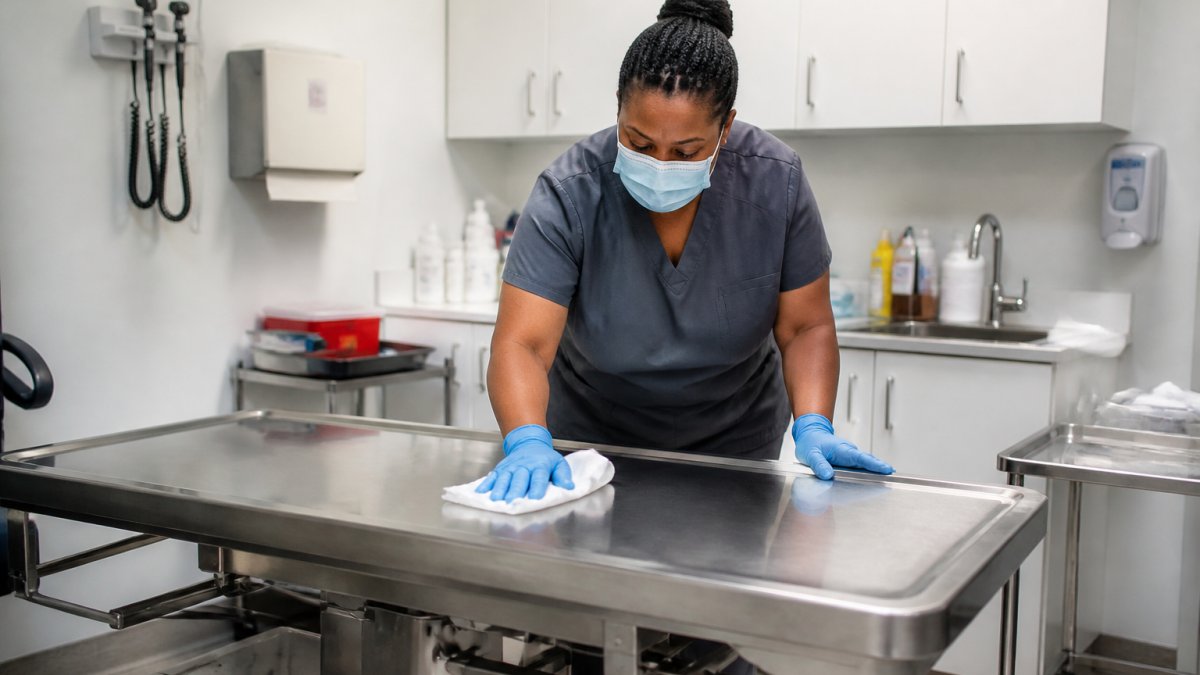
A working checklist for a clinic or medical office includes:
- Exam tables and patient chairs disinfected between visits
- Door handles, light switches, and reception counters wiped daily
- Restrooms cleaned and restocked on a set schedule
- Floors mopped with the correct product for each surface type
- Waiting room furniture and high-touch items sanitized
- Biohazard and sharps containers handled per protocol
- Floor care, including VCT maintenance and carpet cleaning, on a rotation
Infection control and patient safety depend on consistency, not effort. That’s why a written checklist matters more than a vendor’s sales pitch.
Skipping a written scope is the most common mistake. If your contract doesn’t list high-touch surfaces and floor care frequency, you have no way to prove the work was done when an inspection or audit arrives.
Medical Cleaning Service Contract Checklist: Accountability in Writing
A medical cleaning service contract checklist should lock in scope, frequency, quality controls, and remedies before the first crew arrives. Accountability is a document, not a promise.
Service-Level Agreements and Measurable Quality Controls
A service-level agreement defines what “clean” means in measurable terms. Quality audits, inspection scores, and response times turn a vague standard into something you can enforce.
Insist on these contract elements:
- Named scope of work for each space and surface type
- Cleaning frequency by area, not a single blanket schedule
- Quality audit schedule with scoring criteria
- Complaint response window and escalation path
- Staff vetting and training requirements
- Transition costs and termination terms
- Insurance and bonding documentation
The real difference between vendors comes down to what happens after a complaint. A contract with a defined response window protects you. A handshake does not.
Medical Office Deep Cleaning: A Line Item, Not an Upsell
Medical office deep cleaning is periodic, intensive cleaning of floors, vents, and equipment that routine service doesn’t reach.
Treating deep cleaning as an upsell creates two problems. First, it disappears from the budget until something forces it. Second, you lose the ability to negotiate frequency and pricing up front.
Facilities that schedule deep cleaning on a fixed rotation, quarterly or twice a year depending on traffic, get better long-term savings than those who call for it reactively.
Ask your vendor to build deep cleaning into the contract as a scheduled service with a defined frequency. Vendors price recurring work lower than one-off emergency jobs, and you avoid scrambling before an inspection.
Where Outsourcing Wins and Where It Falls Short
Outsourcing wins for most small and mid-size medical facilities. It falls short for large hospitals with enough scale to justify a dedicated environmental services department. The difference is not philosophy, it is volume, risk, and management bandwidth.
Facility-Type Comparison
Different care settings carry different cleaning risk and staffing needs. The trade-offs shift accordingly.
| Facility Type | Typical Cleaning Risk | Staffing Need | Outsourcing Fit |
|---|---|---|---|
| Small clinic or medical office | Moderate, exam rooms, waiting areas | Part-time or shared | Strong fit |
| Outpatient or surgery center | High, procedure rooms, sterile fields | Trained, consistent crew | Strong fit with clinical training |
| Multi-site practice | Moderate to high, varies by site | Coordinated across locations | Strong fit with one vendor |
| Long-term care or assisted living | High, resident rooms, common areas | Daily, dedicated | Fit depends on vendor experience |
| Hospital | Very high, isolation, OR, ICU | Dedicated environmental services | Often better in-house |
Where Outsourcing Wins
- Small clinics and medical offices without the volume for full-time staff
- Multi-site operators who want one vendor and one invoice across locations
- Facilities that value predictable monthly costs over variable payroll
- Teams without the time to recruit, train, and supervise cleaning staff
- Sites that need documented quality audits for accreditation or inspection
Where It Falls Short
- Large hospitals where in-house staff already have specialized training
- Facilities with unique protocols a general vendor can’t match
- Buyers who choose purely on the lowest bid and get the service that price buys
- Sites with highly specialized equipment or isolation requirements the vendor has not handled before
A Simple Break-Even Check
Before you request quotes, run this quick check. It will tell you whether outsourcing is likely to pay off.
- Estimate the fully loaded hourly cost of your in-house cleaner, wages plus taxes, benefits, insurance, and supplies.
- Add your own supervision time at a realistic hourly value.
- Add a turnover and coverage contingency.
- Multiply by the hours per week the space actually needs.
- Compare that total to the vendor’s monthly contract fee, including any transition or onboarding cost.
If the in-house total is higher and your manager’s time is already stretched, outsourcing is usually worth the cost. If the in-house total is lower and you have reliable staff, the case is weaker.
The Honest Caveat
Not every outsourcing claim holds up. A vendor’s marketing will tell you outsourcing always saves money. It doesn’t. It saves money when your in-house indirect costs are real and recurring, and it costs more when they aren’t. The facilities that get the best results treat the decision as a total-cost question, not a bid comparison, and they put the scope, quality audits, and response times in writing before the first crew arrives.
Small and mid-size medical offices, multi-site clinics, outpatient centers, and facilities that want predictable costs and documented quality controls without managing cleaning staff directly.
Conclusion: Running the Numbers on Medical Cleaning
The math on medical cleaning comes down to total cost of ownership. Count wages, benefits, supplies, supervision, turnover, and infection-control risk on the in-house side. Then compare that against a fixed contract fee with a written scope and quality audits.
That’s where we come in. Heavenly Touch Janitorial Services, LLC brings over 20 years of experience to medical facilities, with customized cleaning solutions built around your budget and a full scope that includes floor care, VCT maintenance, carpet cleaning, and post-construction cleanup.
Frequently Asked Questions
What are the costs associated with outsourcing medical cleaning?
Outsourced medical cleaning typically involves a recurring service fee that bundles labor, supervision, supplies, and equipment. Because every facility has different square footage, patient volume, and surface types, pricing depends on those factors, so most providers quote after a walkthrough. The fee replaces the wages, benefits, payroll taxes, recruitment, training, and turnover costs you would carry with an in-house crew. Request a written quote that itemizes what is included before comparing it to your current internal spend.
Is outsourcing medical cleaning more cost-effective than hiring an in-house team?
It depends on facility size and scale. Small-to-midsize medical offices often find outsourcing more cost-effective because they cannot spread the cost of a dedicated cleaning department across enough square footage. Larger facilities with steady, full-time cleaning needs may find in-house staffing competitive. Run a total cost of ownership comparison that includes wages, benefits, supplies, equipment, supervision, and turnover, not just the hourly rate. The break-even point usually sits where your internal cleaning hours no longer justify a full department.
What should healthcare facilities look for in a medical cleaning provider?
Look for documented infection control procedures, staff training records, and a written service agreement with measurable quality standards. Ask how the provider handles medical office deep cleaning, floor care, and post-construction cleanup, since those tasks require different equipment and detail than routine janitorial work. Confirm the provider carries insurance and can supply references from similar healthcare settings. A provider that cannot show you a checklist or audit process is a risk in any facility where patient safety matters.
How can a facility compare cleaning bids fairly?
Compare bids on scope, not just price. Ask each provider to quote the same task list, frequency, and square footage so you are comparing like for like. Require line items for labor, supplies, equipment, supervision, and any deep cleaning or floor care add-ons. Check whether the contract includes quality audits, complaint response times, and transition costs. A lower bid that excludes deep cleaning or infection control detail is not cheaper, it just moves those costs to a separate invoice later.
How often should a medical facility receive deep cleaning?
Deep cleaning frequency depends on patient volume, facility type, and whether the space sees high-touch surfaces throughout the day. Many medical offices schedule deep cleaning quarterly or twice a year, with more frequent cycles in procedure rooms or areas with higher infection risk. Routine cleaning handles daily surfaces, while deep cleaning addresses floors, vents, and equipment edges that build up over time. Build deep cleaning into your service agreement as a scheduled line item rather than an emergency call.