
Table of Contents
- Why Medical Office Cleaning Standards Change in 2026
- OSHA Medical Office Cleaning Requirements You Must Follow
- Daily, Weekly, and Monthly Cleaning Tasks
- High-Touch Surface Cleaning Frequency in Clinical Settings
- Healthcare-Grade Cleaning Supplies Checklist
- Infection Control Protocols and Specific Pathogen Response
- Digital Audit Trails and Ventilation Standards: What Competitors Miss
- Conclusion
- Frequently Asked Questions
Last Updated: September 18, 2026
Why Medical Office Cleaning Standards Change in 2026
A medical office cleaning standards checklist 2026 looks different from the version most facility managers filed away two years ago. Inspectors now ask for documentation, not just a clean waiting room. That shift matters because a cleaning program that satisfies a visual walkthrough can still fail a regulatory audit. Below, we’ll break down the daily, weekly, and monthly tasks, the OSHA requirements that apply to your staff, and the two areas most checklists still ignore entirely.
OSHA Medical Office Cleaning Requirements You Must Follow
OSHA does not publish a single “medical office cleaning rule.” Instead, its bloodborne pathogens standard (29 CFR 1910.1030) governs any workplace where employees could reasonably anticipate contact with blood or other potentially infectious materials. For a medical office, that means your cleaning staff need a written exposure control plan, hepatitis B vaccination offered at no cost, and appropriate PPE for tasks involving bodily fluid cleanup.
Treating a medical office like a standard commercial space is the most common compliance mistake. Exam rooms, labs, and restrooms carry biohazard waste and sharps containers that require specific handling procedures, and a crew without bloodborne pathogen training should never touch them.
Daily, Weekly, and Monthly Cleaning Tasks
Cleaning frequency in a clinical environment is not arbitrary; it follows contact risk, patient volume, and the likelihood that a surface will transfer pathogens between people. The table below summarizes how a typical medical office schedules its core tasks, followed by the room-level detail that most checklists leave out.
| Frequency | Core Tasks | Primary Goal |
|---|---|---|
| Daily | Disinfect high-touch surfaces, restrooms, floors, trash | Pathogen reduction |
| Weekly | Detail dusting, carpet vacuuming, glass, vents | Preventative maintenance |
| Monthly | Deep extraction, wall washing, equipment detail | Long-term hygiene standards |
Daily Cleaning Tasks
Every day, your crew should disinfect high-touch surfaces, restock restrooms, empty and reline all waste receptacles, and damp-mop or vacuum floors using microfiber technology. Exam tables and patient chairs get disinfected between sessions, not just at day’s end. Trash handling deserves special attention: biohazard waste goes into designated containers, never the standard bin.
- Waiting room and reception: Disinfect door handles, check-in counters, pens, clipboards, armrests, and magazine or tablet surfaces. Empty the lobby trash and wipe the water cooler or coffee station.
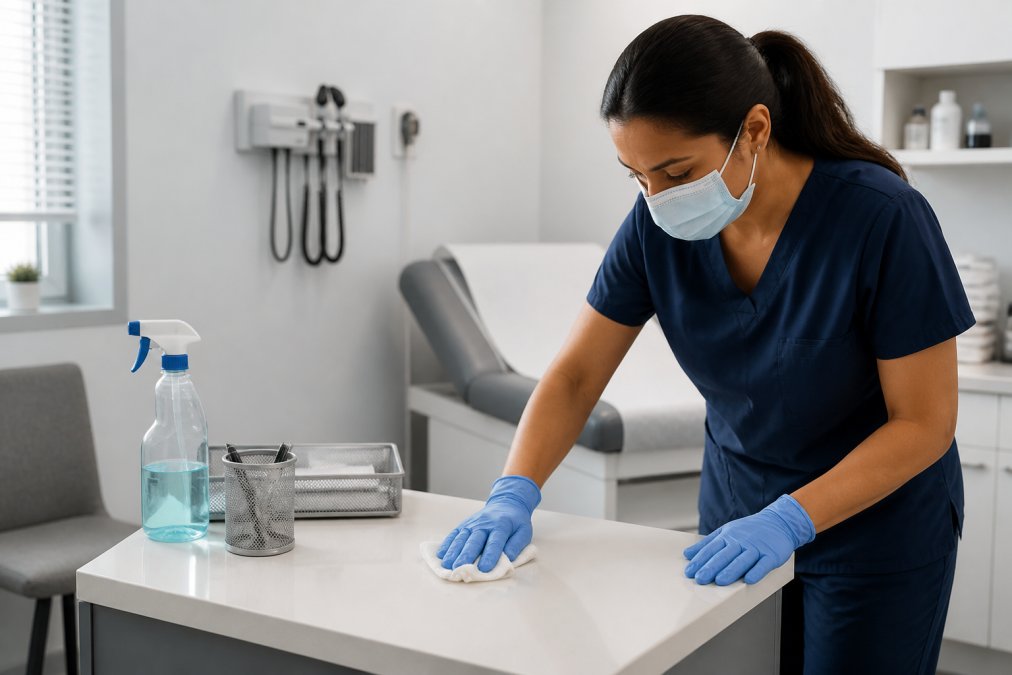
- Exam rooms: Disinfect the exam table between every patient, along with blood pressure cuffs, otoscope handles, and any reusable equipment the clinician touches. Wipe the sink and counter, and check sharps containers for fill level.
- Restrooms: Disinfect all fixtures, restock paper and soap, and mop with a dedicated restroom mop head. Never carry a restroom mop into a clinical area.
- Clinical support areas: Wipe lab counters, centrifuge exteriors, and specimen transport surfaces. Empty biohazard bins and confirm lids seal.
- Floors and corridors: Damp-mop hard floors with microfiber and vacuum carpeted paths with HEPA filtration. Entry mats should be vacuumed daily because they trap the highest concentration of outdoor soil.
Weekly Cleaning Duties
Weekly work moves from surface disinfection to preventative cleaning. That includes detail-dusting vents and light fixtures, vacuuming carpets with HEPA filtration, cleaning interior glass, and wiping down waiting room furniture. This is also when a supervisor should inspect for damage that daily crews might miss.
A weekly pass should also cover:
- Upholstery and fabric: Vacuum waiting room chairs and lobby sofas, including under cushions, where food and skin cells accumulate.
- High ledges and ceiling fixtures: Dust return-air grilles, ceiling fans, and light diffusers. Dust here re-enters the breathing zone when HVAC runs.
- Refrigerators and breakroom appliances: Wipe handles, shelves, and door gaskets in staff breakrooms and medication refrigerators (exterior only unless your policy permits interior cleaning).
- Waste and recycling stations: Scrub exterior bins, replace liners, and disinfect lids and pedals.
- Restroom deep touchpoints: Descale faucets, clean mirror edges, and scrub grout lines that daily mopping does not reach.
Monthly Deep Cleaning
- Carpet hot-water extraction: Required in waiting rooms and corridors to remove embedded soil and allergens that vacuuming leaves behind.
- Hard-floor machine scrub and recoat: Strip and refinish VCT in lobbies and corridors; burnish or auto-scrub sealed concrete and LVT.
- Wall and baseboard washing: Spot-wash scuffs and disinfect baseboards, especially in exam rooms and corridors where gurneys and carts rub walls.
- HVAC vent and diffuser cleaning: Remove and wash grilles; vacuum duct openings within reach. This pairs with the ventilation discussion later in this article.
- Equipment and furniture detail: Move exam tables, rolling stools, and waiting room chairs to clean beneath and behind them. Wipe the undersides of counters and the tops of cabinets.
- Documentation review: Reconcile the month’s cleaning logs against the schedule, flag missed rooms, and update the exposure control plan if tasks changed.
Build your schedule around patient volume, not the clock. A clinic that sees 60 patients before noon needs its exam rooms disinfected between every visit and its waiting room touched up mid-day, not just at close.
High-Touch Surface Cleaning Frequency in Clinical Settings
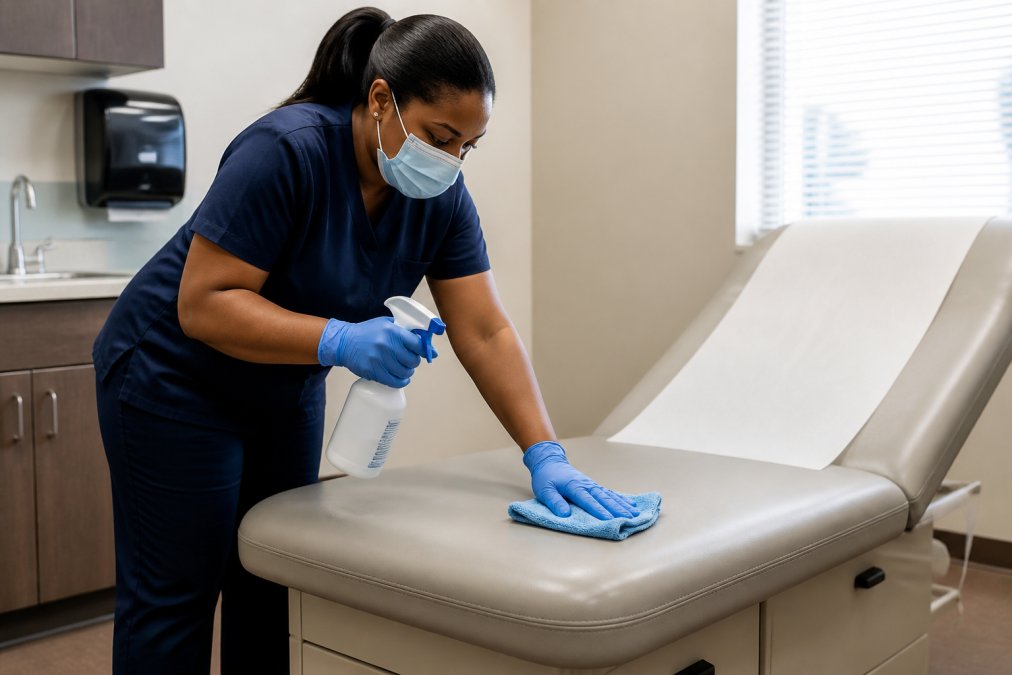
High-touch surfaces in clinical settings should be disinfected at least daily, and far more often in exam rooms, triage areas, and patient restrooms. Door handles, light switches, countertops, keyboards, and chair arms are the priority. Surface contact time, also called dwell time, is the detail most crews skip: a disinfectant must stay wet on the surface for the full time listed on its label to actually work.
Healthcare-Grade Cleaning Supplies Checklist
A healthcare-grade cleaning supplies checklist should include EPA-registered disinfectants, microfiber cloths and mops, color-coded tools, and appropriate PPE. The EPA maintains a list of registered antimicrobial products, and the CDC publishes guidance on disinfecting healthcare environments; both are worth bookmarking as reference points. You can find the current product list through EPA’s registered disinfectant list.
- EPA-registered disinfectant matched to your target pathogens
- Microfiber cloths and mops, color-coded by zone
- Nitrile gloves, masks, and eye protection
- Biohazard waste bags and sharps handling supplies
- No-touch cleaning tools for restrooms
Infection Control Protocols and Specific Pathogen Response
Infection control protocols define how a facility responds when a specific pathogen appears, not just how it cleans on a normal day. Standard precautions apply to all patients; transmission-based precautions add isolation cleaning steps for contact, droplet, or airborne threats. Specific pathogen protocols matter because a norovirus outbreak, for instance, requires a disinfectant effective against non-enveloped viruses and a longer dwell time than routine cleaning.
Pathogen-Specific Protocols Most Checklists Skip
The CDC’s Guideline for Disinfection and Sterilization in Healthcare Facilities is the reference point for the protocols below. The key variables are the disinfectant’s EPA-registered kill claims, the required contact (dwell) time, and whether the surface is a spore-former that resists standard chemistry.
Building the Protocol Into the Checklist
A pathogen-specific protocol only works if the crew can execute it under time pressure. Three design rules help:
- Name the product and the dwell time on the room card. Do not write “disinfect exam room.” Write the product name, the dilution if applicable, and the required wet time.
- Separate spore and non-spore tools. C. diff and norovirus response kits should be stored separately from routine supplies so a crew never reaches for the wrong chemistry during an outbreak.
- Document the trigger. Define what activates an outbreak protocol, a confirmed lab result, a clinician notification, or a patient report, and who is authorized to activate it.
A disinfectant that is not left wet for its full label contact time does not achieve its kill claim. This is the single most common failure in outbreak response, and it is invisible on a visual inspection.
Routine cleaning handles the everyday load. Pathogen-specific protocols handle the events that generate headlines. A medical office cleaning standards checklist 2026 should contain both, and the pathogen section should name the chemistry, the dwell time, and the trigger for each threat.
Digital Audit Trails and Ventilation Standards: What Competitors Miss
Two gaps show up in nearly every medical office cleaning checklist. The first is digital audit trail integration: instead of paper sign-off sheets that get lost, more facilities now use apps that timestamp each room cleaned and store compliance documentation for regulatory audit. The second is post-pandemic ventilation standards, which address airborne contaminants through improved filtration and airflow, a factor cleaning alone cannot solve.
Conclusion
The hardest part of medical office cleaning is not the daily wipe-down; it is proving, month after month, that your facility meets hygiene standards when an inspector or a patient asks. Heavenly Touch Janitorial Services, LLC brings more than 20 years of experience to commercial and medical spaces, with specialized floor care including propane buffing and VCT maintenance, carpet cleaning, and turnkey post-construction cleanup.
Frequently Asked Questions
What should be included in a daily medical office cleaning checklist?
A daily medical office cleaning checklist should cover exam tables, door handles, light switches, waiting room chairs, and restrooms. Use EPA-registered disinfectants on all high-touch surfaces, and allow the full dwell time listed on the product label. Empty biohazard waste containers, replace sharps containers when three-quarters full, and spot mop floors with a hospital-grade cleaner. Document each task with initials and time stamps so your practice can show compliance during a regulatory audit.
How often should high-touch surfaces be disinfected in a medical facility?
High-touch surfaces in patient-care areas should be disinfected at least once daily, and more often in high-traffic zones like waiting rooms or triage. The CDC recommends cleaning these surfaces between patients when contamination is likely. For busy practices, a mid-day wipe-down of door handles, countertops, and check-in kiosks reduces cross-contamination risk. Always follow the disinfectant’s surface contact time, since many products need one to ten minutes of wet contact to work.
How do I ensure my medical office cleaning meets OSHA standards?
To meet OSHA medical office cleaning requirements, train staff on bloodborne pathogen protocols, provide appropriate PPE, and maintain a written exposure control plan. Use color-coded microfiber cloths to separate patient-care areas from restrooms, and label all secondary chemical containers. Keep safety data sheets accessible for every product on site. Review your program annually and after any incident involving bodily fluid cleanup. Documenting training dates and inspections helps demonstrate compliance during an audit.
What is the difference between cleaning, sanitizing, and disinfecting in healthcare?
Cleaning removes visible dirt, dust, and debris from surfaces. Sanitizing reduces bacteria to levels considered safe by public health standards. Disinfecting kills or inactivates nearly all pathogens on a surface, but only when the product stays wet for its full dwell time. In a medical office, you typically clean first, then disinfect. Skipping the cleaning step can leave biofilm that prevents the disinfectant from reaching the surface, which undermines infection control.
What supplies belong on a healthcare-grade cleaning supplies checklist?
A healthcare-grade cleaning supplies checklist should include EPA-registered disinfectants, microfiber cloths and mops, color-coded cleaning tools, nitrile gloves, eye protection, gowns, and biohazard bags. Add a hospital-grade floor cleaner, a neutral pH cleaner for sensitive equipment, and hand sanitizer for staff and patient areas. Keep a spill kit with absorbent material and disinfectant for bodily fluid cleanup. Replace microfiber cloths when they show wear, and never reuse a cloth between patient rooms without laundering.
What are the CDC guidelines for cleaning medical offices?
CDC guidelines for medical offices emphasize routine cleaning of high-touch surfaces, proper disinfection with EPA-registered products, and hand hygiene for staff. Use an EPA List N disinfectant for emerging viral pathogens, and follow the label’s dwell time. Clean and disinfect shared equipment between patients. Manage biohazard waste separately from regular trash. Train staff on standard precautions and provide PPE. Documenting these steps supports both infection control and compliance with workplace safety rules.
How do I verify that my cleaning vendor actually follows these standards?
Ask for a written scope of work that names the disinfectants used, their EPA registration numbers, and the dwell times your staff will follow. Request sample inspection reports or digital audit trails showing time-stamped completion of high-touch surface cleaning. Confirm that cleaners are trained on bloodborne pathogens and PPE protocols. A vendor that tracks compliance documentation and responds to complaints with corrective actions gives you a verifiable record if a regulatory audit occurs.