
Table of Contents
- Why VCT Flooring in Offices Dulls So Fast
- Your Daily VCT Maintenance Schedule for Offices
- Weekly and Monthly Tasks: Buffing, Burnishing, and Recoating
- VCT Strip and Wax Frequency: How Often Is Enough?
- Signs Your VCT Needs Stripping, Not Just Recoating
- Troubleshooting Scuffs, Stains, and Black Marks
- DIY vs. Commercial Floor Cleaning Services: A Cost-Benefit Look
- Conclusion: Build a Floor Maintenance Schedule That Holds Up
- Frequently Asked Questions
Last Updated: October 4, 2026
Why VCT Flooring in Offices Dulls So Fast
VCT flooring is a vinyl composite tile surface finished with a protective polymer coating, and that coating, not the tile itself, is what takes the abuse in a busy office. Soil embedment is the main culprit: grit tracked in from parking lots and sidewalks acts like sandpaper under foot traffic, grinding the finish into a dull, patchy film within weeks. We’ve watched offices across the Charleston area spend heavily on stripping and refinishing when the real problem was a missing daily routine.
Your Daily VCT Maintenance Schedule for Offices
A workable daily routine takes under an hour for most office footprints and prevents most of the damage that forces premature stripping. The core tasks are dust mopping, spot cleaning, and damp mopping with the right chemistry.
- Dust mop first. Push a wide microfiber dust mop down long, straight lanes, overlapping each pass. This removes loose grit before it gets ground into the finish.
- Spot clean scuffs and spills. Tackle black marks and coffee drips immediately with a neutral cleaner and a microfiber cloth. Fresh marks lift easily; set-in marks need more aggressive methods.
- Damp mop with a pH-neutral cleaner. Never flood the floor. A properly wrung mop leaves a thin film that dries in minutes.
- Inspect high-traffic areas. Entryways and break rooms need a second pass most days.
- Log what you see. A quick note on dull spots or new scratches tells your floor care provider exactly where to focus.
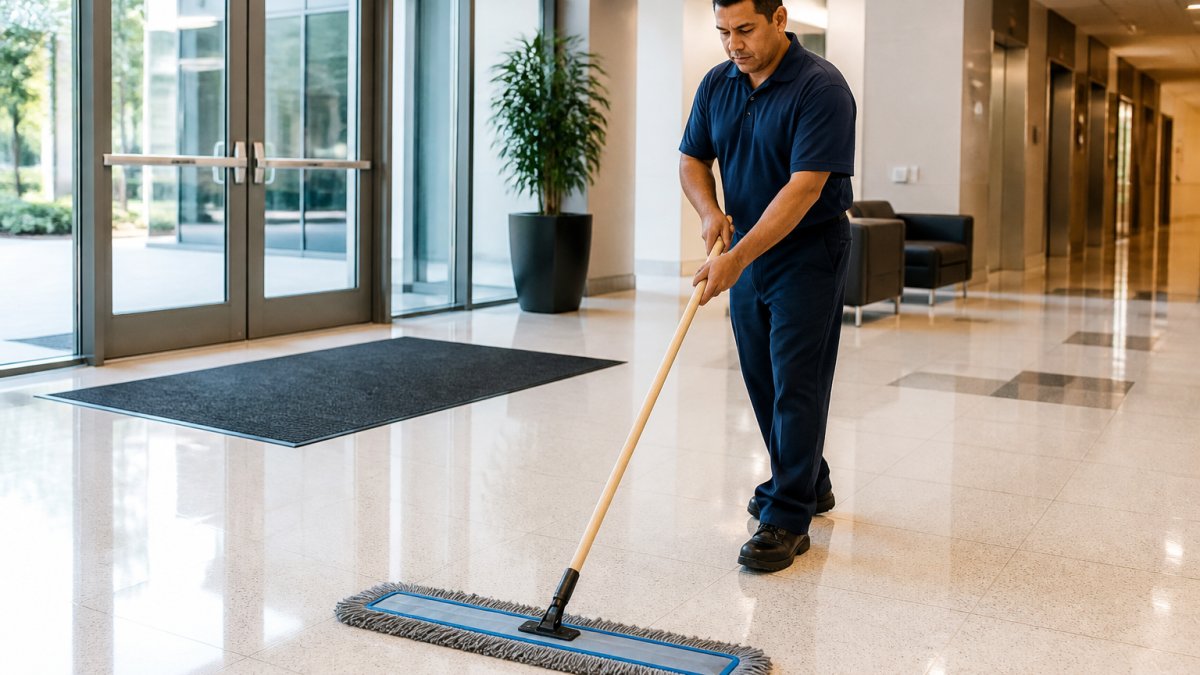
Damp mopping with a dirty mop head is worse than not mopping at all. It redistributes soil across the finish. Swap mop heads at least daily in high-traffic buildings, and never use the same head for restrooms and open office floors.
Weekly and Monthly Tasks: Buffing, Burnishing, and Recoating
Weekly and monthly work restores gloss and buys time between full strip-and-wax cycles. Spray buffing handles light scuffing and dull patches; burnishing with a high-speed buffer brings back a mirror finish on floors that still have solid finish depth. Recoating adds a fresh layer of floor finish over a clean, intact surface, and it’s the single most cost-effective way to extend floor longevity.
Spray Buffing vs. Burnishing: Which Your Floor Needs
Choose spray buffing when the finish is intact but lightly scuffed, and burnishing when the finish is healthy and you simply want maximum gloss. Spray buffing uses a light mist of finish or a dedicated spray-buff solution worked in with a buffer and a soft pad. Burnishing runs a high-speed buffer, typically 1,500 RPM or higher, dry across the floor with a burnishing pad.
| Task | Frequency | Equipment | Best For |
|---|---|---|---|
| Dust mopping | Daily | Microfiber dust mop | Removing grit before it embeds |
| Damp mopping | Daily to 3x weekly | Mop, neutral cleaner | Light soil and spills |
| Spray buffing | Weekly to monthly | Rotary buffer, soft pad | Light scuffs, dull patches |
| Burnishing | Weekly to monthly | High-speed buffer | Restoring gloss on healthy finish |
| Recoating | Every 2-4 months | Mop, applicator | Adding finish depth in traffic lanes |
Burnishing a floor that still has loose grit on it grinds that grit straight into the finish and creates swirl scratches that only stripping removes. Always dust mop immediately before burnishing.
VCT Strip and Wax Frequency: How Often Is Enough?
Most offices need a full VCT strip and wax frequency of once or twice a year, but the correct interval depends on traffic, entrance control, and how disciplined the daily routine is. A medical office with heavy foot traffic and multiple exterior doors may need stripping every six to nine months. A low-traffic professional suite with good walk-off mats can stretch to 18 months or longer.
How to Calculate Your Building’s Actual Strip Interval
Rather than guessing from a calendar, count the variables that actually drive finish wear:
- Daily foot traffic per entrance. A main lobby with 500+ daily entries wears finish roughly three times faster than a side entrance with 50.
- Exterior door count. Each uncontrolled entrance adds tracked grit. Four or more exterior doors serving the same floor typically shortens the strip cycle by a third.
- Walk-off mat coverage. At least 10 to 15 feet of matting at every entrance captures most tracked soil. Less than that and grit reaches the finish.
The Finish-Depth Test: A Concrete Diagnostic
You don’t need a lab to know when finish is failing. Two field tests work in any office:
- The coin test. Drag a coin edge lightly across a traffic lane. If it leaves a white scratch that buffs out, finish is intact. If it cuts through to bare tile, you’re due for stripping.
- The gloss-meter comparison. Compare a traffic lane to a protected area under a desk or in a corner. A drop of more than 20 to 30 gloss units between the two signals finish failure, not just dullness.
What Happens If You Strip Too Early vs. Too Late
- Stripping too early wastes labor and chemical, removes finish that still had months of life, and exposes tile to unnecessary wear during the bare period before new coats cure.
- Stripping too late lets soil bond to bare tile, allows finish to yellow and flake, and often requires aggressive stripping chemistry that shortens tile life.
The goal is to strip when finish has failed, not on a fixed schedule. A floor care provider that walks your building quarterly and logs finish depth by zone will catch the right window every time.
Strip when the finish has failed, not when the calendar says so. The coin test and a gloss comparison between traffic lanes and protected areas give you a concrete answer in under five minutes.
Signs Your VCT Needs Stripping, Not Just Recoating
Stripping is the right call when the finish has failed, not when it’s merely tired. Recoating over a failing finish traps dirt and produces a patchy, uneven result that looks worse than the floor did before. These are the signals that it’s time to strip:
- Finish worn through to bare tile in traffic lanes
- Yellowing or discoloration that buffing won’t lift
- Finish flaking, peeling, or bubbling at edges
- More than four or five coats of accumulated finish
The difference between stripping and waxing matters: stripping removes all old finish down to bare tile, while waxing (recoating) adds a new layer on top. Recoat while the finish is healthy; strip only when it has failed.
Troubleshooting Scuffs, Stains, and Black Marks
Most marks on a VCT floor come out with the right technique and the right pad, without touching a stripping solution. Match the method to the mark:
- Black heel marks: A pencil eraser or a dedicated scuff remover pad. For stubborn marks, a light pass with a buffer and a white pad.
- Ink and marker: Dampen a microfiber cloth with isopropyl alcohol and dab, don’t rub. Test in a corner first.
- Coffee and soda: Blot immediately with a neutral cleaner. Dried sugar leaves a sticky film that attracts more soil.
- Adhesive residue: A citrus-based adhesive remover, then rinse with clean water.
Never use abrasive pads or powdered cleansers on VCT. They scratch the finish and create microscopic channels that hold soil, which makes the floor look dirty again within days.
DIY vs. Commercial Floor Cleaning Services: A Cost-Benefit Look
In-house daily maintenance makes sense for almost every office. Full stripping, burnishing with commercial equipment, and finish application usually don’t. The break-even point comes down to equipment cost, labor hours, and consistency.
The Real Equipment and Labor Math
Before deciding to bring VCT care in-house, price out what the full scope actually requires:
- High-speed burnisher (1,500+ RPM): A commercial-grade unit runs well into four figures, weighs 80 to 100 pounds, and requires a dedicated operator.
- Rotary buffer for spray buffing: A mid-grade unit is affordable, but the learning curve for pad selection and solution control is real. Poor technique creates swirl marks that only stripping removes.
- Auto-scrubber for damp mopping at scale: Necessary above roughly 10,000 square feet; below that, a mop and bucket still work.
- Stripping chemistry and PPE: Stripper, neutralizer, finish, applicators, and proper gloves and eye protection add up per cycle.
The Break-Even Framework
Use these thresholds as a starting point:
- Under 5,000 square feet, low traffic, one or two entrances: In-house daily care plus a contracted annual strip is usually the cheapest path.
- 5,000 to 15,000 square feet, moderate traffic: In-house daily care plus contracted burnishing and stripping typically beats buying equipment outright.
- Over 15,000 square feet or multiple buildings: A turnkey commercial floor cleaning services program almost always wins on labor, equipment amortization, and consistency.
- Medical, educational, or high-hygiene environments: Professional programs bring the chemistry knowledge and documentation these settings require.
The Hidden Cost of In-House Programs
The biggest failure mode isn’t equipment, it’s consistency. In-house floor care typically degrades after the first few months as staff turnover, competing priorities, and skipped burnishing cycles take their toll. A floor that gets dust mopped five days a week for three months and then twice a week for the next three ages faster than one on a steady contracted schedule.
When to Outsource vs. When to Train Internally
Outsource when:
- You need stripping, burnishing, or finish application at commercial scale
- You manage multiple properties and want one vendor and one schedule
- Your building has medical, educational, or post-construction cleanup requirements
- Staff turnover makes consistent daily care unreliable
Train internally when:
- Your footprint is small and traffic is light
- You already have janitorial staff with time to absorb daily dust mopping and damp mopping
- You have a reliable provider for the periodic heavy work
This is where a commercial floor cleaning services partner earns its keep. Heavenly Touch Janitorial Services, LLC handles propane buffing and VCT maintenance as part of a turnkey program, so daily care, periodic burnishing, and stripping can be managed efficiently. For offices managing multiple properties, consolidating floor care, carpet cleaning, post-construction cleanup, and deep cleaning under one provider removes the coordination headache entirely.
Offices with more than 5,000 square feet of VCT, multiple entrances, or medical and educational hygiene requirements. At that scale, equipment and labor costs make professional floor care the cheaper option over a 12-month cycle.
Conclusion: Build a Floor Maintenance Schedule That Holds Up
Offices that keep their VCT floors looking new aren’t spending more, they’re spending on the right cadence. Daily dust mopping and damp mopping prevent 80% of the damage that leads to premature stripping.
If managing that schedule in-house isn’t realistic, Heavenly Touch Janitorial Services, LLC builds customized floor care programs for offices, medical facilities, and schools across the Charleston area.
Frequently Asked Questions
How often should I wax my VCT flooring in an office setting?
Most offices need a full strip and wax every 6 to 12 months, depending on foot traffic. High-traffic areas like lobbies and hallways may need it more often, while private offices can stretch longer. Between strips, you can recoat one or two layers of floor finish every 4 to 8 weeks to keep the gloss level up. Watch for a dull finish and patchy wear patterns as your signal that it’s time.
Does VCT flooring need a sealer, or is wax enough?
New VCT needs a sealer before the first coats of floor finish. The sealer fills the porous surface and prevents the wax from soaking in unevenly, which helps you avoid a patchy look. After that first application, you typically don’t need to reseal unless the floor is stripped down to bare tile. Stripping solution removes both the wax and the sealer, so you start fresh each time.
Can professional cleaning services restore dull or yellowed VCT?
Yes. Dull, yellowed VCT usually means layers of old finish and embedded soil have built up. A commercial floor cleaning service uses a rotary floor scrubber and stripping solution to remove everything down to the bare tile, then applies fresh sealer and floor finish. The result is a restored gloss level and better slip resistance. It’s often faster and more even than a DIY strip, especially in large offices.
What’s the difference between spray buffing and burnishing VCT?
Spray buffing uses a high-speed buffer with a light mist of floor polish to remove scuff marks and restore shine in small areas. Burnishing uses a propane or electric high-speed buffer with a buffing pad to generate heat and bring up the gloss across larger sections. Burnishing is faster for big open floors, while spray buffing works better for spot fixes and tight spaces.