
Table of Contents
- How Post Construction Cleaning Services Pricing Works in 2026
- Key Factors That Drive Your Construction Cleanup Costs
- Commercial Post Construction Cleaning Rates and What They Cover
- Your Post Construction Cleaning Checklist: Rough Clean, Final Clean, and Touch-Up
- How to Remove Construction Dust From Office Spaces Safely
- Sample Estimates by Property Size and Cleaning Phase
- How to Get an Accurate Cleaning Estimate and Compare Quotes
- Frequently Asked Questions
Last Updated: October 7, 2026
How Post Construction Cleaning Services Pricing Works in 2026
Post construction cleaning services pricing is quoted per project, not per hour, because the work depends on square footage, debris volume, and how many cleaning phases the job requires. At Heavenly Touch Janitorial Services, LLC, we build every estimate from a walkthrough, then price the rough clean, final clean, and touch-up clean separately so contractors and property owners can see exactly what each stage costs.
That structure matters because construction cleanup is not one task. It is a sequence, and skipping a phase usually costs more later.
Most bids you receive will fall into one of three models:
- Square-footage rate: a per-square-foot figure applied to the total floor area
- Flat-rate pricing: one number for a defined scope of work
- Hourly rate plus materials: labor hours multiplied by a crew rate, with supplies billed separately
A common mistake is comparing a square-footage quote against a flat-rate quote as if they cover the same work. They rarely do. One may include cabinet interiors and window tracks; the other may stop at surface cleaning.
Ask every bidder to state whether their number covers a single pass or a phased clean. A low square-footage rate that only covers rough cleanup will look cheaper than a full final clean, and it is not the same job.
Key Factors That Drive Your Construction Cleanup Costs
No two construction sites produce the same cleanup bill. Four variables move the number more than anything else, and understanding them is how you tell a fair quote from a padded one.
Square Footage and Project Size
Larger properties take longer to clean, but the cost per square foot usually drops as size increases. Crews can work in parallel across a big open floor plate, while a small renovation forces the same setup and travel time into fewer billable square feet. Property size also determines crew size, and crew size drives labor hours.
Debris Levels and Dust Conditions
Fine dust is the expensive part. Drywall dust settles into HVAC vents, light fixtures, cabinet interiors, and floor seams, and it takes repeated passes to remove. Heavy construction debris, adhesive residue, and paint overspray add labor hours on top of standard surface cleaning. A job with light dust after a cosmetic renovation prices very differently from a full gut renovation with exposed framing.
Commercial Post Construction Cleaning Rates and What They Cover
Commercial post construction cleaning rates run higher per square foot than residential rates, but the reason is not simply size. It is access, scheduling, and scope density. A 40,000-square-foot office floor and a 4,000-square-foot home can carry the same dust load, yet the commercial job adds freight elevator coordination, badge access, after-hours labor premiums, and a restroom count that multiplies fixture cleaning across dozens of stalls.
What separates commercial work from residential work:
- Access and logistics. Loading docks, freight elevators, security check-in, and parking constraints add non-cleaning labor hours that never appear on a residential job.
- After-hours scheduling. Many commercial clients require crews to work nights or weekends so tenants are not disrupted, and those shifts carry wage premiums.
- Restroom and break room density. A single-family home has two or three bathrooms. A commercial floor can have twenty or more fixtures, each needing descaling, polishing, and hardware detailing.
- Floor area and machine work. Large open floor plates call for ride-on scrubbers, propane buffing, and VCT maintenance rather than hand mopping, which changes both equipment cost and crew composition.
- Phased handover schedules. Multi-tenant buildings often release floors in stages, so crews return multiple times instead of completing one continuous clean.
How Project Type Changes the Scope
| Project Type | What Drives the Rate | Scope Notes |
|---|---|---|
| Office buildout | After-hours access, restroom count | Dust from ceilings and vents, floor machine work, glass partitions |
| Retail space | Open hours pressure, display fixtures | Debris haul, floor stripping and finishing, entryway glass |
| Multifamily building | Unit count, staged handover | Per-unit final clean, common areas, stairwells, elevator cabs |
| Renovation within an occupied building | Containment, protection of existing finishes | Negative air, plastic sheeting, daily reset of occupied zones |
A renovation inside an occupied building is the most underestimated category. Crews must contain dust so tenants can keep working, protect existing finishes from the cleaning process itself, and reset shared areas every day. That containment labor is real work, and it belongs in the bid.
What a commercial rate should cover:
- Debris removal and disposal from interior spaces
- Dust removal from ceilings, vents, and light fixtures
- Floor cleaning, including stripping, finishing, and VCT maintenance where specified
- Windows, glass partitions, and entryways
- Fixtures, restroom surfaces, and cabinet interiors
- A final walkthrough before handover
What it often excludes: exterior pressure washing, hazardous material abatement, landscaping debris, and disposal fees for large-volume waste. Those exclusions are where budgets get surprised.
The most common contract dispute in commercial cleanup is debris disposal. If the bid does not name who hauls away construction waste and who pays the disposal fee, assume you are paying it.
Your Post Construction Cleaning Checklist: Rough Clean, Final Clean, and Touch-Up
A post construction cleaning checklist should split work into three phases, because each phase happens at a different point in the build schedule and each one prices differently. Cleaning too early wastes money; cleaning too late delays the certificate of occupancy.
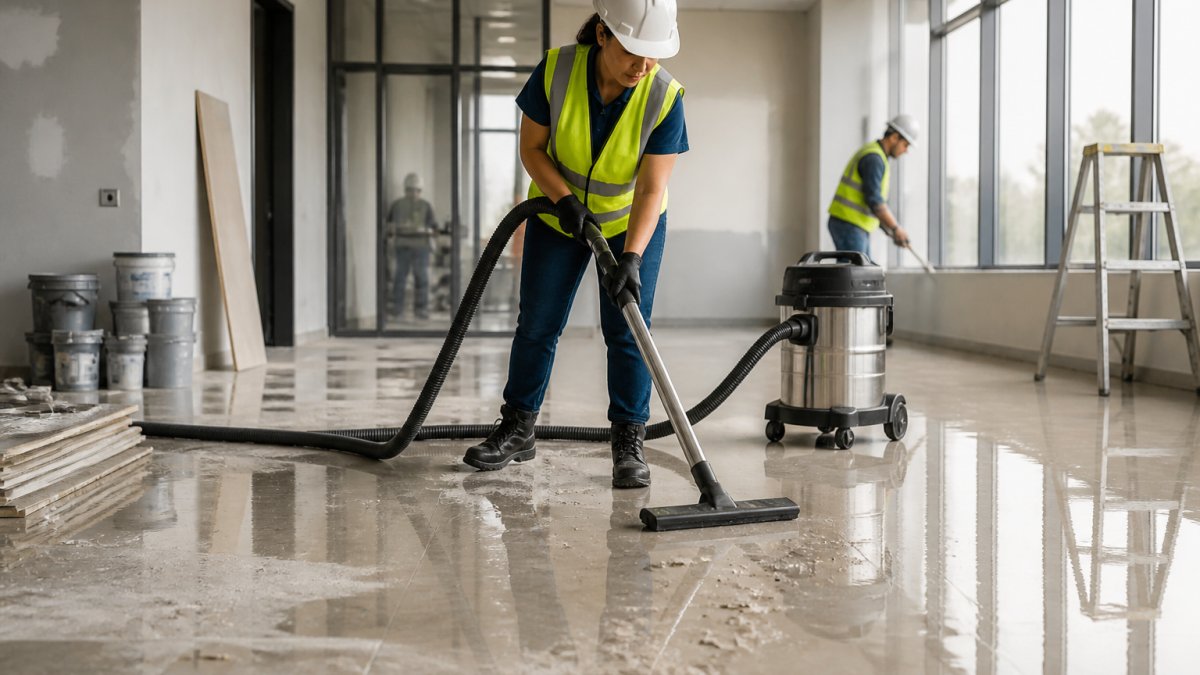
Phase 1: Rough Clean. Happens after major trades finish but before final finishes go in. Crews remove bulk debris, scrape floors, and clear large surfaces. This is the heaviest and least detailed phase.
Phase 2: Final Clean. Happens after all trades are done. This covers dust removal from every surface, floor cleaning, window and fixture cleaning, and interior detailing.
Phase 3: Touch-Up Clean. Happens immediately before handover or move-in. Crews address dust that settled after the final clean, plus scuffs and marks from inspections, photography, or furniture delivery.
| Phase | Timing | Typical Scope | What It Prevents |
|---|---|---|---|
| Rough clean | After trades, before finishes | Bulk debris, floor scraping | Damage to new finishes |
| Final clean | After all trades complete | Dust, floors, windows, fixtures | Failed inspection walkthrough |
| Touch-up clean | Before handover | Settled dust, scuffs, marks | Buyer or tenant complaints |
How to Remove Construction Dust From Office Spaces Safely
Removing construction dust from an office safely means controlling it before you wipe it. Dry sweeping and standard vacuums push fine particles back into the air, where they settle again on desks, vents, and equipment. The right sequence is top-down, with filtration.
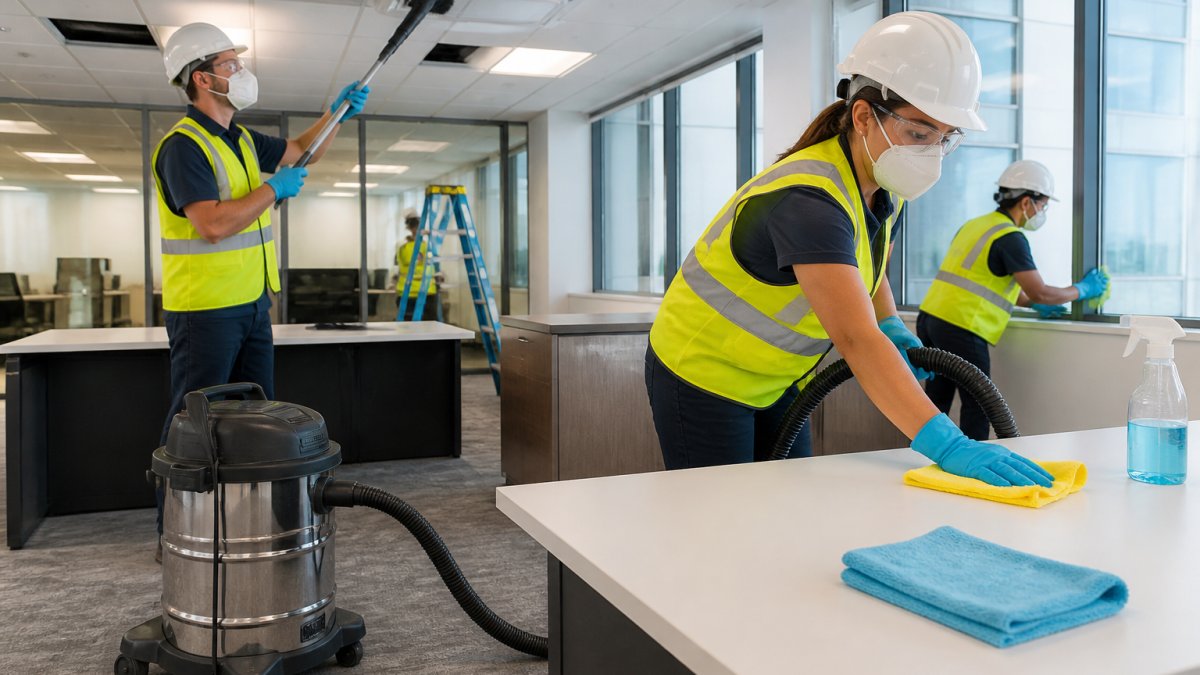
The sequence we follow:
- Seal off the work zone with plastic sheeting to contain dust spread.
- Change HVAC filters and cover vents before cleaning begins.
- Vacuum ceilings, vents, and light fixtures with HEPA-filtered equipment.
- Wipe horizontal surfaces top-down with damp microfiber, not dry cloths.
- Clean floors last, using equipment matched to the surface type.
- Run a final air check and re-wipe any surface that shows fresh settling.
The EPA guidance on indoor air quality during renovation explains why containment and filtration matter more than cleaning products for fine particulate control. Skipping containment means you clean the same dust twice.
Dust removal is a filtration problem before it is a wiping problem. Contain the dust, capture it with HEPA equipment, and clean top-down. Wiping first just moves it around.
Sample Estimates by Property Size and Cleaning Phase
Post construction cleaning estimates scale with both size and phase count, but the number that matters is not a single total. It is how the total splits across rough, final, and touch-up work. Below is how a phase-by-phase estimate is assembled, so you can compare bids on structure rather than on one bottom-line figure.
How a Phase-by-Phase Estimate Is Built
A transparent estimate prices each phase as its own line, because each phase carries a different labor intensity per square foot.
| Phase | Relative Labor Intensity | What Drives the Hours |
|---|---|---|
| Rough clean | Highest per pass, lowest detail | Bulk debris volume, floor scraping, number of dumpsters |
| Final clean | Highest detail, most passes | Dust depth in vents and fixtures, floor type, glass count |
| Touch-up clean | Lowest hours, highest timing sensitivity | Settled dust, scuffs from inspections and furniture delivery |
A rough clean on a gut renovation can consume more labor hours than the final clean, because debris volume dominates. A cosmetic refresh flips that ratio, with the final clean carrying most of the hours. That is why a single square-footage rate quoted across all three phases is almost always wrong for one of them.
Sample Scope by Property Size
| Property Size | Phases Typically Needed | Crew Size | Scope Notes |
|---|---|---|---|
| Small office suite | Final clean only | 2-3 cleaners | Surface dust, floors, restrooms |
| Mid-size retail space | Rough plus final clean | 3-4 cleaners | Debris haul, floor machine work |
| Large commercial floor | All three phases | 4-6 cleaners | Phased scheduling, after-hours work |
| Multi-building property | All three phases, staged | Rotating crews | Per-building handover schedule |
Two properties of identical square footage can land in different rows. A gut renovation with exposed ductwork and heavy drywall dust needs more passes than a cosmetic refresh, and that difference shows up in labor hours, not floor area.
What a Quote Should Itemize
When you compare estimates, look for these line items rather than a lump sum:
- Labor hours by phase, with crew size stated
- Floor care scope, including whether stripping, finishing, or VCT maintenance is included
- Debris removal and disposal, with the responsible party named
- Interior windows, glass partitions, and fixture cleaning
- Any after-hours or access-related labor
- A pre-handover walkthrough before final payment
Ask each bidder to break their number into rough, final, and touch-up lines. A quote that cannot be split by phase is usually a quote that has not been scoped by phase.
How to Get an Accurate Cleaning Estimate and Compare Quotes
An accurate cleaning estimate comes from a site visit, not a phone call. Square footage alone cannot tell a cleaner how much dust is in the vents, how much adhesive is on the floor, or how tight the access is.
When comparing bids, put them side by side on scope, not on the bottom-line number:
- Does the bid list each cleaning phase separately?
- Does it name what is excluded?
- Does it state crew size and estimated labor hours?
- Does it confirm who handles debris disposal?
- Does it include a walkthrough before final payment?
For contractors building a profitable bid on the other side of the table, the same discipline applies in reverse.
At Heavenly Touch Janitorial Services, LLC, we have handled construction cleanup across the Charleston area for over 20 years, from single-suite buildouts to multi-property handovers.
Construction schedules slip, inspections get moved up, and the cleanup phase is usually the one with the least slack.
Frequently Asked Questions
How much should I charge to clean a new construction house?
Rates depend on square footage, debris level, and whether you’re doing a rough clean, final clean, or both. Most cleaners price by square footage or hourly labor. A rough clean after framing typically costs less per square foot than a final clean, which requires detail work on fixtures, cabinet interiors, and windows. For an accurate number, request a custom quote based on your specific job scope and property size.
Is post construction cleaning priced by the hour or by square footage?
Both models exist. Hourly rates work well for smaller jobs or when the scope is uncertain. Square footage pricing gives you a predictable flat rate for larger projects. Many companies combine both: they estimate labor hours based on square footage, then quote a flat rate. Ask which method your provider uses so you can compare bids fairly. A detailed walkthrough before quoting produces the most accurate estimate.
What specific tasks are included in a professional post construction cleanup?
A standard scope covers construction debris removal, fine dust elimination from all surfaces, window and glass cleaning, floor care (including VCT maintenance and carpet cleaning), fixture and cabinet interior wiping, and HVAC vent dust removal. Some companies include exterior window cleaning; others charge extra. Always review the written scope before signing so you know what’s included and what costs extra.
How can I get an accurate estimate for my construction cleanup project?
Schedule a walkthrough with your cleaning provider after construction wrap-up but before final inspection. Point out debris levels, specialty surfaces, and any areas needing extra attention. Provide square footage, number of rooms, and whether you need rough, final, or touch-up cleaning. A provider who inspects the site in person will give you a more reliable quote than one who estimates over the phone.