
Table of Contents
- What Makes a Cleaning Solution Safe for Medical Offices
- EPA Safer Choice Certified Disinfectants: What the Label Actually Means
- Top Eco-Friendly Cleaning Products for Medical Office Environments
- Commercial Floor Care for Medical Offices: Keeping Surfaces Clean and Compliant
- Medical Office Cleaning Standards Checklist 2026
- Regulatory Compliance and Disposal Protocols for Green Cleaning Chemicals
- Cost-Benefit Analysis: Is Eco-Friendly Cleaning Worth It for Medical Facilities?
- Frequently Asked Questions
Last Updated: October 2, 2026
What Makes a Cleaning Solution Safe for Medical Offices
Choosing the best eco-friendly cleaning solutions for medical office environments starts with one hard truth: a product must clean and disinfect to a clinical standard before “green” means anything. This guide from Heavenly Touch Janitorial Services, LLC breaks down which certifications matter, which products hold up under real clinical use, and how to build a compliant green cleaning program.
The Tension Between Disinfection Power and Green Chemistry
The core conflict is simple: the ingredients that kill pathogens fastest are often the harshest, and the gentlest formulas sometimes cannot deliver hospital-grade kill claims. Green cleaning still works in medical offices, the product just has to be matched to the task.
EPA Safer Choice Certified Disinfectants: What the Label Actually Means
A Safer Choice label means the EPA has reviewed the product’s ingredients for human health and environmental impact, not that it carries a disinfectant kill claim. The two certifications are separate, and confusing them is the most common mistake facility managers make.
Green Seal and UL ECOLOGO: The Other Certifications That Matter
Green Seal and UL ECOLOGO certify products against third-party environmental and health standards covering biodegradability, packaging, and volatile organic compounds (VOCs). Neither guarantees disinfection, but both confirm the formula meets an independent benchmark for reduced chemical exposure, supporting occupational safety for your cleaning staff.
Top Eco-Friendly Cleaning Products for Medical Office Environments
The best eco-friendly cleaning solutions for medical office environments balance third-party certification, surface compatibility, and real-world performance. These products consistently hold up in clinical settings.
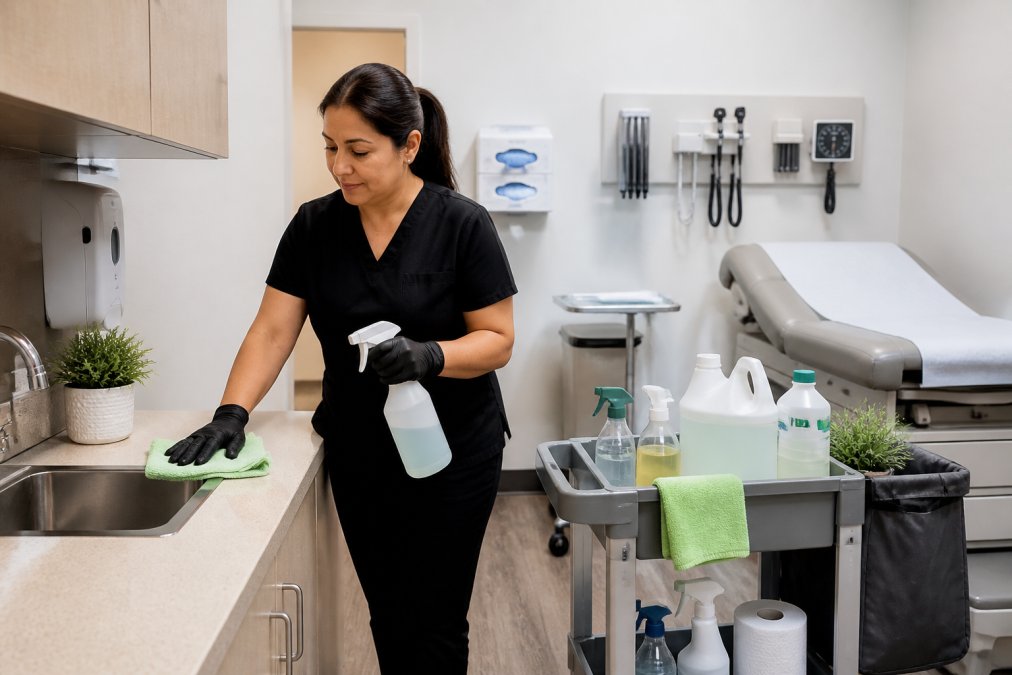
Seventh Generation Professional: Best for Indoor Air Quality
Seventh Generation Professional uses plant-based ingredients and holds EPA Safer Choice certification, with no synthetic fragrances or dyes, a strong fit for exam rooms and waiting areas where indoor air quality affects patients and staff. The tradeoff: heavy industrial grime may need a higher concentration or a dedicated degreaser first.
Ecolab Oasis Pro: Best for High-Volume Facilities
Ecolab Oasis Pro uses ultra-concentrated formulas and closed-loop dispensing systems that cut plastic waste and reduce chemical handling risk. The catch: it requires proprietary dispensing equipment, so it suits facilities ready to commit to a system.
Blueland Commercial: Best for Zero-Waste Operations
Blueland Commercial uses dissolvable tablets and refillable bottles, eliminating single-use plastic and shrinking storage needs in small supply closets. It is EPA Safer Choice certified; the tradeoff is manual mixing per refill. Best for small to medium offices with a genuine waste-reduction goal.
| Product | Certification | Best For | Key Limitation |
|---|---|---|---|
| Seventh Generation Professional | EPA Safer Choice | Indoor air quality | Needs higher concentration for heavy grime |
| Ecolab Oasis Pro | Environmental standards | High-volume facilities | Requires proprietary dispensing equipment |
| Blueland Commercial | EPA Safer Choice | Zero-waste operations | Manual mixing per refill |
| Simple Green Pro HD | Biodegradable formula | Floor and equipment degreasing | Requires careful dilution |
| ECOS Pro | Plant-derived, pH-balanced | Sustainability mandates | Longer dwell time on heavy soils |
Commercial Floor Care for Medical Offices: Keeping Surfaces Clean and Compliant
Commercial floor care for medical offices is where green cleaning gets tested hardest, because flooring takes constant traffic and collects pathogen-carrying debris. Vinyl composition tile (VCT) is common in clinical corridors and waiting rooms and needs a routine that keeps the surface sealed and cleanable.
VCT Maintenance and Propane Buffing in Clinical Settings
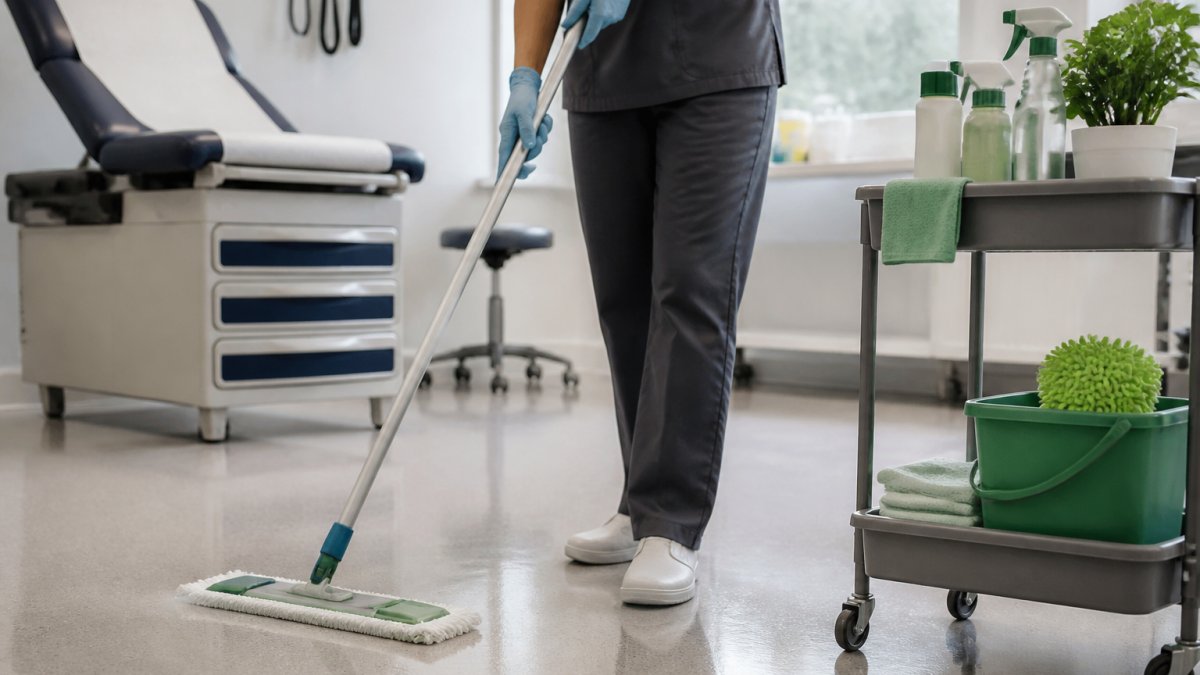
VCT maintenance means stripping, sealing, and finishing on a schedule, plus regular buffing to keep the finish intact, a compromised finish traps soil and makes disinfection less effective. Propane buffing restores gloss and removes the top layer of soil without harsh chemical strippers. Pair it with microfiber mopping, which lifts more soil with less water than traditional mops.
Medical Office Cleaning Standards Checklist 2026
A medical office cleaning standards checklist 2026 should cover high-touch surfaces, floor care, restrooms, and waste handling on a defined schedule. Use this as a starting point and adjust to your facility’s patient volume.
- Disinfect high-touch surfaces (door handles, switches, counters) daily
- Clean and disinfect exam tables between patients
- Mop floors with microfiber and a pH-neutral cleaner daily
- Buff and maintain VCT finish on a set rotation
- Service restrooms with dedicated, color-coded tools
- Empty and sanitize waste receptacles, following disposal protocols
- Verify dilution ratios on all concentrated products
- Log completion for regulatory compliance
Color-coded microfiber is the detail most facilities skip. Assigning one color per zone (restrooms, exam rooms, common areas) prevents cross-contamination without extra labor, and it makes staff training faster.
Regulatory Compliance and Disposal Protocols for Green Cleaning Chemicals
Regulatory compliance is where eco-friendly cleaning programs most often fall apart, because “green” and “compliant” are governed by two different rulebooks. A product can carry a Safer Choice mark and still fail an inspection if it is not used according to its EPA-registered label.
The Three Federal Rulebooks That Apply to Medical Office Cleaning
EPA registration and label law. Every disinfectant sold with a kill claim must carry an EPA registration number, and label directions, dilution ratio, contact (dwell) time, surface compatibility, and disposal, are legally binding under FIFRA. Using a registered disinfectant at a weaker dilution than labeled, or wiping it off before the dwell time elapses, is a misuse of a registered pesticide. That applies equally to plant-based formulas.
Disposal Protocols: Where Green Products Still Have Rules
Disposal protocols for eco-friendly chemicals are simpler than for harsh solvents, but not automatic, and medical offices face an extra layer.
- Concentrates. Never pour a concentrated product down a drain at full strength. Dilute to the directed strength first, then dispose according to the label and any local publicly owned treatment works (POTW) requirements.
- Empty containers. Rinse and dispose of empty primary containers per the label and local solid waste rules. Do not repurpose EPA-registered pesticide containers for other uses.
- Disinfectant wipes and spent solution. These are regulated as solid waste in most medical office settings unless they meet the state definition of regulated medical waste. When in doubt, follow the label and your state environmental agency’s guidance.
- Regulated medical waste (RMW). Materials saturated with blood or other potentially infectious materials fall under RMW rules, primarily state-administered. Green cleaning products do not change how RMW is segregated, packaged, or manifested.
- Safety Data Sheets (SDS). OSHA’s Hazard Communication Standard (29 CFR 1910.1200) requires an SDS for every hazardous chemical in the workplace, accessible to employees during their shift. Keep SDS binders or digital access current for every product, green or not.
HMIS and NFPA Ratings: A Practical Shortcut for Training
HMIS and NFPA ratings give staff a fast read on health, flammability, and reactivity hazards. Products rated HMIS 0-0-0 carry the lowest risk in all three categories, simplifying handling, storage, and training. That does not replace the SDS or label, but it is a useful filter when comparing two certified products.
A green certification is not a compliance shortcut. If a product carries an EPA registration number, its label directions are enforceable. Train staff on dwell time and dilution for every registered disinfectant in the program, and keep the SDS accessible on every shift.
Building the Compliance File
A defensible green cleaning program typically includes: a written cleaning and disinfection protocol mapped to each area type; the EPA registration number and label for every disinfectant; SDS access for all products; dilution and dwell-time training records; and a disposal procedure distinguishing solid waste from regulated medical waste.
Cost-Benefit Analysis: Is Eco-Friendly Cleaning Worth It for Medical Facilities?
Is eco-friendly cleaning worth it for medical facilities? The math depends on how you frame it. Shelf price per bottle almost always favors conventional products; total cost per clean, including dilution economics, waste handling, staff safety, and the cost of a failed inspection, usually favors a well-run green program.
The Cost Categories That Actually Move the Number
Product cost per clean, not per bottle. Concentrated green formulas are diluted on site, often at ratios between 1:64 and 1:256, so one container replaces many ready-to-use bottles. Compare cost per diluted quart or gallon, not sticker price. Ready-to-use green products often cost more per clean than conventional RTU products, which is why dilution control matters.
A Simple Comparison Framework
When evaluating a switch, compare the current program and the proposed green program across the same six lines:
| Cost Line | What to Measure |
|---|---|
| Product cost per clean | Cost per diluted gallon or quart, not per container |
| Dispensing and equipment | Upfront capital, refill cost, service contract terms |
| Labor per room | Dwell time plus application and removal time |
| Waste and storage | Packaging volume, disposal frequency, closet footprint |
| Safety and training | Training hours, PPE, incident history |
| Compliance | Documentation time, inspection outcomes, rework |
The Transition Cost Nobody Budgets For
The upfront effort is real: dispensing systems, refillable bottles, staff training on new dilution ratios and dwell times, and updated SDS files all take time. Expect a two- to three-month adjustment period before the program stabilizes.
Compare total cost per clean, not shelf price. The product line is usually a wash; labor, waste, safety, and compliance are where the green program earns its return.
Where a Turnkey Service Changes the Math
For medical offices without an in-house custodial team, the question becomes whether one provider can handle floor care, deep cleaning, and post-construction cleanup under a single contract. Consolidating those services reduces coordination costs and keeps the green protocol consistent across every task.
Frequently Asked Questions
What are the EPA requirements for green cleaning in medical offices?
The EPA does not mandate specific green cleaning products for medical offices, but its Safer Choice program certifies products that meet strict human health and environmental standards. Facilities receiving federal funding or pursuing LEED certification may need to document the use of certified products. For disinfection, any product claiming to kill pathogens must be registered with the EPA and carry an EPA registration number on the label. Always verify that a disinfectant has both Safer Choice certification and EPA registration if you need pathogen reduction alongside environmental safety.
Are eco-friendly disinfectants effective against pathogens in clinical settings?
EPA-registered eco-friendly disinfectants meet the same efficacy standards as conventional products. They must demonstrate kill claims against specific pathogens, including those causing healthcare-associated infections, through EPA-required testing. Products like Clorox EcoClean and Ecolab Oasis Pro carry EPA registration and are approved for use in medical environments. The key is matching the disinfectant’s kill claims to the pathogens your facility needs to address, then following the label’s dwell time precisely. Green certification does not reduce disinfectant efficacy when the product is EPA-registered.
How do green cleaning products improve indoor air quality in medical facilities?
Conventional cleaning products often contain volatile organic compounds that evaporate into the air during and after use. These VOCs can trigger respiratory irritation, especially in patients with asthma or chemical sensitivities. EPA Safer Choice certified products limit or eliminate VOCs, synthetic fragrances, and harsh solvents. Switching to fragrance-free, pH-neutral formulas reduces chemical exposure for staff who clean daily and for patients in waiting areas. Improved indoor air quality supports better health outcomes and can reduce complaints about odors or irritation.
What certifications should I look for in eco-friendly medical cleaning supplies?
Prioritize EPA Safer Choice certification, which evaluates every ingredient against human health and environmental criteria. Green Seal and UL ECOLOGO offer third-party certification for commercial cleaning products and equipment. For disinfectants, confirm EPA registration for pathogen kill claims. Products with HMIS 0-0-0 ratings indicate minimal health, flammability, and reactivity hazards, which matters for staff safety. Look for biodegradable, plant-based ingredients and packaging that supports waste reduction. Certification logos should appear on the product label with a certification number you can verify.
Can eco-friendly cleaning solutions meet OSHA bloodborne pathogen standards?
OSHA’s bloodborne pathogens standard requires employers to provide appropriate disinfectants for surfaces contaminated with blood or other potentially infectious materials. The standard does not specify product brands but requires EPA-registered disinfectants with proven efficacy against HIV, hepatitis B, and hepatitis C. Several eco-friendly options meet this requirement, including EPA-registered products from Clorox EcoClean and Ecolab. Pair green disinfectants with proper personal protective equipment, written exposure control plans, and staff training to maintain full compliance while reducing chemical exposure.
Green cleaning in a medical office only works when certification, dilution, and floor care all line up, and that is a lot to manage alongside patient care. Heavenly Touch Janitorial Services, LLC handles the full scope for medical offices across the Charleston area, from EPA Safer Choice products and VCT maintenance to post-construction cleanup and turnkey deep cleaning. Get started with Heavenly Touch Janitorial Services, LLC and schedule a free estimate for a cleaner, healthier facility.