
Table of Contents
- Why Construction Dust Removal Is Critical for Office Environments
- What You’ll Need: Tools and Equipment for Construction Dust Removal
- Step-by-Step: How to Remove Construction Dust from Office Spaces
- Post-Construction Cleaning Checklist for Facility Managers
- Choosing the Right HEPA Filter Vacuum for Construction Dust
- How to Clean HVAC Vents After Construction
- When to Bring in Commercial Deep Cleaning Services
- Common Mistakes to Avoid During Construction Dust Removal
- Frequently Asked Questions
Last Updated: September 23, 2026
Why Construction Dust Removal Is Critical for Office Environments
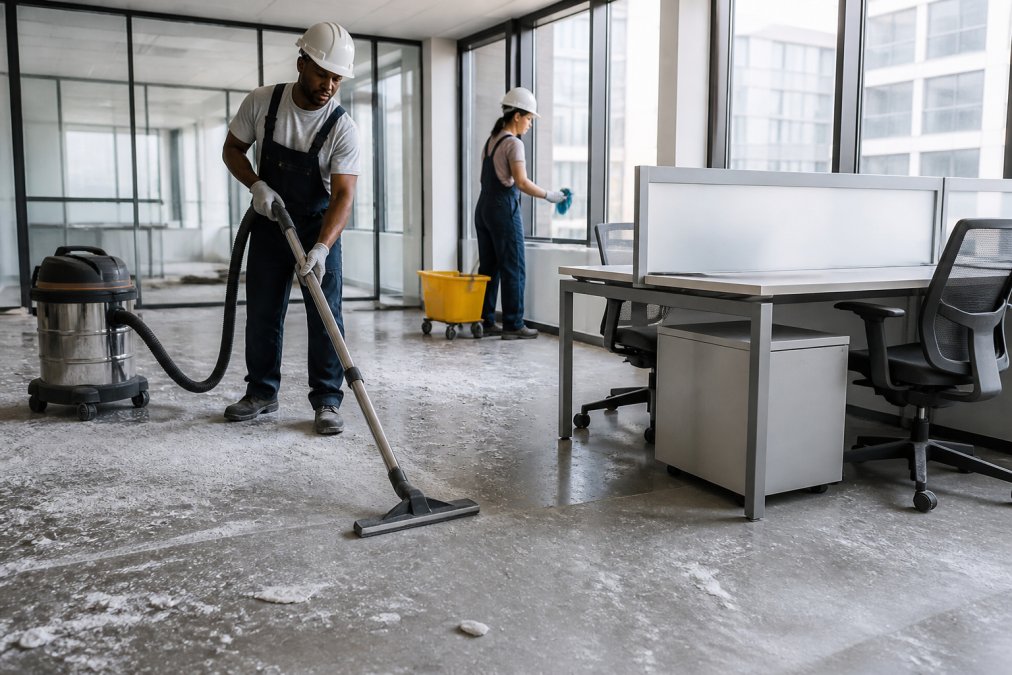
Construction dust is not ordinary household dirt. It is a mix of fine particulate matter, silica dust, drywall dust, and debris that settles into every surface of an office. According to OSHA guidance on respirable crystalline silica, exposure to silica dust can cause serious lung disease in workers who breathe it in over time.
What You’ll Need: Tools and Equipment for Construction Dust Removal
The right tools decide how fast and how thorough your cleanup will be. A standard broom and shop vac will spread dust, not remove it. Here is what to gather before you start:
- HEPA filter vacuum rated for fine particulate matter
- Microfiber cloths for damp wiping
- Two buckets: one for clean water, one for rinse water
- Nitrile gloves and N95 or P100 respirators
- Plastic sheeting and tape for dust containment
- Vent covers to block debris from entering HVAC returns
- HEPA air scrubber for airborne particles
- Damp mop and floor cleaner safe for your surface type
Wrap the vacuum’s exhaust filter area with a damp cloth during the first pass. It catches the fine dust that escapes before the filter fully loads.
Step-by-Step: How to Remove Construction Dust from Office Spaces
The proven method is a top-down approach: start high, finish low, and never clean a surface twice. In an office, though, the sequence has one office-specific wrinkle that residential guides skip: electronics. Fine construction dust is abrasive and mildly conductive, and it settles into server intakes, printer paper paths, and keyboard switches where a damp cloth can do more harm than good.
Step 1: Prep the Space and Contain the Dust
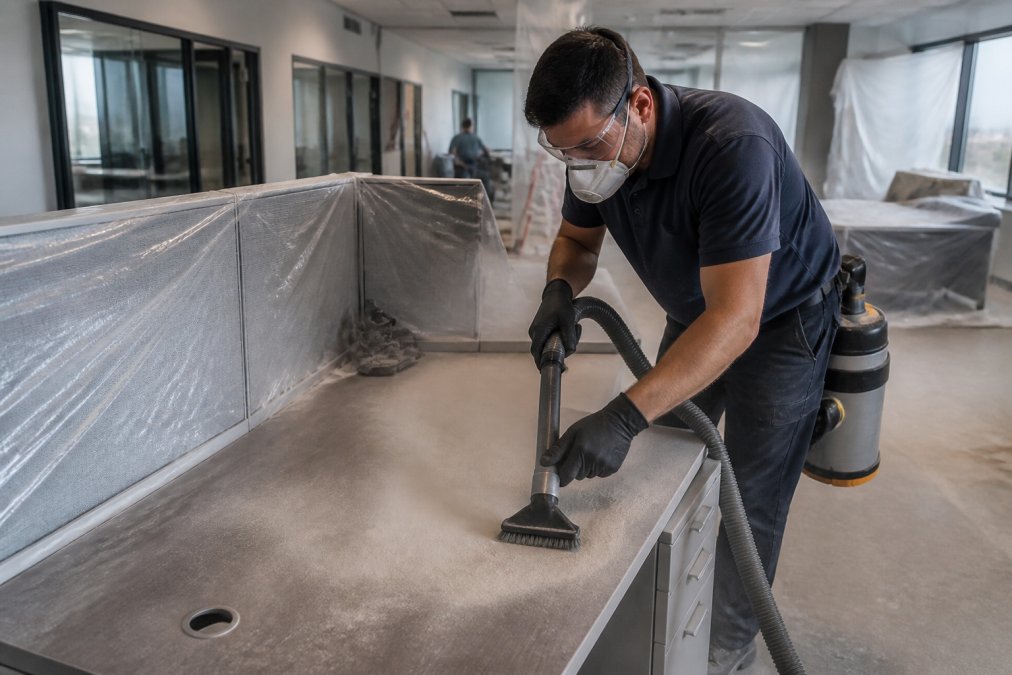
Seal off the work zone before you clean anything. Tape plastic sheeting over doorways and open shelving. Cover vents so dust does not get pulled into the HVAC system while you work.
Step 2: Clean Top-Down, Starting with Ceilings and Vents
Start at the ceiling and work downward. Dust light fixtures, ceiling tiles, and vent covers first. Use a HEPA vacuum with a brush attachment, not a broom.
Step 3: Damp Wipe Surfaces and Vacuum Thoroughly
Damp wiping beats dry dusting every time. A dry cloth pushes fine dust into the air. A slightly damp microfiber cloth traps it.
Wipe in this order:
- Light fixtures and ceiling edges
- Walls and baseboards
- Desks, tables, and counters
- Electronics and keyboards
- Chairs and upholstery
Step 4: Clean Office Electronics with Anti-Static Care
This is the step most guides skip. Office electronics trap dust differently than home electronics because they run longer, sit in shared air, and often share a room with a printer or copier that generates its own paper dust.
Work in this order:
- Keyboards and mice. Turn them off and unplug them. Use a can of compressed air in short bursts at an angle, then follow with a microfiber cloth lightly dampened with isopropyl alcohol. Never spray liquid directly onto a keyboard.
- Monitors and screens. Use a microfiber cloth and a screen-safe cleaner. Do not use paper towels, which can scratch anti-glare coatings.
- Desktop towers and laptop vents. Vacuum the exterior intake and exhaust vents with a HEPA vacuum on low suction. Do not open the case unless you have anti-static grounding equipment and IT approval.
- Printers and copiers. Vacuum the exterior and the paper tray area. Do not blow compressed air into a printer; it drives toner and dust deeper into the mechanism.
- Servers and network racks. These should be handled by IT or a specialist. If dust has reached a server room, the room needs its own containment and filtration plan before anyone wipes a single rack.
Step 5: Final Floor Care and Air Scrubbing
Floors are last, always. Damp mop hard surfaces after vacuuming. For carpet, run the HEPA vacuum a final time.
Sequence is everything: ceilings, vents, walls, surfaces, electronics, then floors. Break the order and you clean the same surface twice.
Post-Construction Cleaning Checklist for Facility Managers
A written post-construction cleaning checklist keeps your team consistent. It also gives you proof of a job done right. Use this as a starting point:
- HVAC system shut off and vents covered
- Work zone sealed with plastic sheeting
- Ceilings, light fixtures, and vents vacuumed
- Walls and baseboards damp wiped
- Desks and counters damp wiped
- Electronics and keyboards cleaned with care
- Upholstery and furniture vacuumed
- Hard floors damp mopped
- Carpet vacuumed twice
- Air scrubber run for several hours
- Final walkthrough with a flashlight
Choosing the Right HEPA Filter Vacuum for Construction Dust
A HEPA filter vacuum is the single most important tool for construction dust removal. It traps fine particulate matter that standard vacuums release back into the room.
Look for three things:
- True HEPA filtration with a sealed system
- A filter rating suited to fine dust, not just large debris
- A hose and brush kit for reaching vents and crevices
How to Clean HVAC Vents After Construction
Cleaning HVAC vents after construction protects your whole building. Dust left in the system recirculates for weeks and undoes your surface work.
Here is the process:
- Turn off the HVAC system first
- Remove and clean vent covers and grilles
- Vacuum inside the duct openings with a HEPA vacuum
- Wipe grilles with a damp microfiber cloth
- Replace filters with new ones rated for fine particles
- Schedule a professional duct inspection for heavy jobs
Never run the HVAC system during cleanup. Doing so pulls dust into the ducts and can spread it to clean areas of the building.
When to Bring in Commercial Deep Cleaning Services
Some jobs are too big or too risky for an in-house team. Commercial deep cleaning services make sense when:
- The renovation covered a large area
- Silica dust or heavy debris is present
- The HVAC system needs full duct cleaning
- You need the space ready on a tight timeline
- Your staff lacks HEPA equipment or respirators
- Sensitive electronics, servers, or a server room are in the affected zone
- The space must pass an air quality check before employees return
Verifying the Space Is Actually Safe to Reoccupy
Before you tell employees to come back, verify the air, not just the surfaces. A practical approach used by many facility teams:
- Run a HEPA air scrubber in the space for several hours after the final surface pass.
- Use a portable air quality monitor that reads particulate matter (PM2.5 and PM10). Compare readings inside the cleaned space against an outdoor baseline or an unaffected area of the building.
- Repeat the reading after 24 hours with the HVAC running normally. If particulate levels climb, dust is still in the ducts or on high surfaces.
- Document the readings alongside your cleaning checklist. This gives you a record if an employee raises a concern.
Workplace Safety Expectations
Construction dust in an office is a workplace exposure issue, not just a housekeeping one. Fine particulate matter and respirable crystalline silica are the two concerns most often cited in workplace safety guidance. If your team is doing the cleanup, they need proper respirators, gloves, and eye protection, and they need to know when to stop and call a professional.
Turnkey Post-Construction Cleanup and Floor Care
Heavenly Touch Janitorial Services, LLC handles post-construction cleanup, floor cleaning services, and turnkey property transitions across the Charleston area. That means one crew manages containment, HEPA vacuuming, surface and electronics cleaning, floor care, vent cleaning, and the final air scrub, so you are not coordinating three vendors and hoping the sequence holds.
Common Mistakes to Avoid During Construction Dust Removal
Most failed cleanups come down to a handful of repeat mistakes. Here are the ones we see most:
- Skipping containment. Dust spreads to clean areas and you start over.
- Dry dusting. It just moves fine dust into the air.
- Cleaning floors first. You re-dust them when you move to ceilings.
- Running the HVAC mid-clean. Dust recirculates through the building.
- Using a standard vacuum. It releases fine particles back into the room.
- Forgetting electronics. Dust in keyboards and vents causes overheating.
- Skipping the final air scrub. Airborne particles settle after you leave.
Frequently Asked Questions
What is the easiest way to remove construction dust?
The easiest method is a top-down approach using a HEPA filter vacuum and damp microfiber cloths. Start by vacuuming ceilings and vents, then work down to walls, furniture, and floors. Damp wiping traps fine particulate matter instead of pushing it back into the air. For large offices or heavy dust, a commercial deep cleaning service can handle the job faster and more thoroughly.
How long does it take for construction dust to settle and dissipate?
Fine dust particles can stay airborne for hours or even days after work stops. Heavier particles settle within a few hours, but silica dust and drywall dust may linger much longer without proper ventilation and air scrubbing. Running HEPA air scrubbers and changing HVAC filters speeds up the process. In most offices, a full professional cleaning removes settled dust in one visit.
Is construction dust harmful to office equipment and air quality?
Yes. Fine dust gets into computer fans, printers, and HVAC systems, causing overheating and premature failure. It also lowers indoor air quality and can trigger respiratory issues. Silica dust is a known health hazard. Using a HEPA filter vacuum for construction dust and covering electronics during work reduces the risk. After construction, a deep cleaning of all surfaces and vents restores air quality.
Should I use a vacuum or a damp cloth for construction dust?
Use both. A HEPA vacuum removes the bulk of dust from floors, carpets, and vents without spreading it. Damp microfiber cloths then capture the remaining fine particulate matter on hard surfaces. Avoid dry dusting or standard vacuums, which blow particles back into the air. For the best results, vacuum first, then damp wipe, and finish with damp mopping.
Construction dust cleanup is hard to get right the first time, and shortcuts show up within days. If you would rather hand it to a team that does this daily, Heavenly Touch Janitorial Services, LLC can help. We bring HEPA filtration, top-down cleaning, floor care, and turnkey post-construction cleanup to offices, schools, and medical spaces across the Charleston area. Get started with Heavenly Touch Janitorial Services, LLC and schedule a free estimate for a spotless, healthier workplace.