
Table of Contents
- Why Charleston Facility Managers Are Rethinking Full-Time Cleaning Staff
- Commercial Janitorial Service Benefits Over Direct Hiring
- Outsourcing vs In-House Cleaning Costs: A Real Comparison
- Specialized Floor Care and VCT Maintenance Without a Full-Time Hire
- Post-Construction Cleanup Services for Property Transitions
- Hybrid Staffing Models: Combining In-House and Contracted Cleaners
- How to Choose the Right Alternative for Your Charleston Facility
- Frequently Asked Questions
Last Updated: September 30, 2026
Why Charleston Facility Managers Are Rethinking Full-Time Cleaning Staff
Full-time cleaning staff used to be the default for facility managers across the Charleston area. That default is shifting. Payroll, benefits, turnover, and equipment costs keep climbing, while property managers juggle more buildings with tighter budgets. This guide from Heavenly Touch Janitorial Services, LLC walks through the real alternatives to hiring full time site cleaners, from commercial janitorial contracts to hybrid staffing models that blend in-house and contracted crews.
Commercial Janitorial Service Benefits Over Direct Hiring
The biggest commercial janitorial service benefits come down to access and consistency. A contracted provider brings trained crews, commercial-grade equipment, and supervisory oversight without adding anyone to your payroll.
Access to Specialized Equipment and Training
Buying a propane buffer, carpet extractor, and auto-scrubber for one building rarely makes financial sense. Contracted teams already own and maintain that equipment. Their staff also train on surface-specific methods, so VCT, carpet, and hard tile each get the right treatment instead of a one-size-fits-all mop.
Consistent Quality Without Management Overhead
Managing cleaners means scheduling, callouts, and quality checks. A janitorial contract moves that responsibility to the provider. You get a service level agreement, a point of contact, and documented results. When someone calls out sick, the provider covers the shift. You don’t.
Outsourcing vs In-House Cleaning Costs: A Real Comparison
Outsourcing vs in-house cleaning costs rarely favors in-house once you count everything. The hourly wage is only the visible number. A true total cost of ownership (TCO) comparison has to include payroll burden, equipment depreciation, supervisory time, turnover, and the risk costs of misclassification.
The Hidden Costs of a Full-Time Employee
Payroll taxes, workers’ compensation, benefits, paid time off, training, uniforms, and equipment all stack on top of base pay. Add turnover, and you’re re-hiring and re-training every time someone leaves. Contracted labor turns those fixed costs into a predictable service fee.
- Employer payroll taxes (Social Security, Medicare, federal and state unemployment)
- Workers’ compensation premiums, which are rated by class code and claims history
- Health, dental, and retirement contributions where offered
- Paid time off, holidays, and sick leave
- Uniforms, background checks, and onboarding
- Equipment purchase, maintenance, and consumable supplies
- Supervisor time spent scheduling, inspecting, and covering callouts
- Turnover cost, recruiting, interviewing, and re-training each replacement
Total Cost of Ownership: Three Models Side by Side
Rather than compare an hourly wage to a service fee, model three structures against the same scope of work:
| Cost Factor | Full-Time Hire | Contracted Janitorial Service | On-Demand / Gig Labor |
|---|---|---|---|
| Base wages or fees | Hourly wage | Bundled in service fee | Per-task or per-hour rate |
| Payroll taxes and insurance | Employer-paid | Provider-paid | Typically worker-paid (1099) |
| Benefits and PTO | Employer-paid | Not applicable | Not applicable |
| Equipment and supplies | You buy and maintain | Provider supplies | Worker supplies or you supply |
| Supervision and quality checks | Your responsibility | Provider handles | Your responsibility |
| Coverage during absences | You fill the gap | Provider covers | Inconsistent |
| Scheduling and dispatch | Your time | Provider’s time | Your time, per task |
| Turnover exposure | High | Low | Very high |
| Classification risk | None | None | Moderate to high |
The real comparison isn’t hourly wage versus service fee. It’s total cost of ownership, equipment, benefits, turnover, supervisory time, and classification risk, measured against the same scope of work.
The 1099 vs. W-2 Question Most Guides Skip
Most articles on alternatives to full-time cleaners jump straight to software and never address the labor-classification question. That’s a mistake, because the IRS and the Department of Labor apply specific tests to determine whether a worker is an employee (W-2) or an independent contractor (1099).
Key factors include:
- Behavioral control, do you dictate when, where, and how the work is done?
- Financial control, do you control pay, reimbursements, and the worker’s ability to profit or lose?
- Relationship type, are there written contracts, benefits, or a permanency expectation?
Labeling a worker as a 1099 contractor does not, by itself, make them one. The IRS and the Department of Labor look at the actual working relationship, not the paperwork. When in doubt, consult a qualified employment attorney or tax professional.
Where Contracted Service Wins on Cost
Contracted janitorial service tends to win on TCO when:
- Your cleaning demand is periodic or seasonal rather than daily
- You need specialized floor care (propane buffing, carpet extraction, VCT maintenance) that would require capital equipment
- You operate multiple buildings and want one point of accountability
- You want to avoid the management time of scheduling, inspecting, and covering callouts
In-house tends to win when you have a large, steady, single-site scope with enough volume to keep a full crew productive year-round and the management infrastructure to supervise them well.
Specialized Floor Care and VCT Maintenance Without a Full-Time Hire
Specialized floor care and VCT maintenance require equipment and know-how that most single-site teams don’t have. That’s the strongest case for contracting floor work separately, even if you keep some in-house staff.
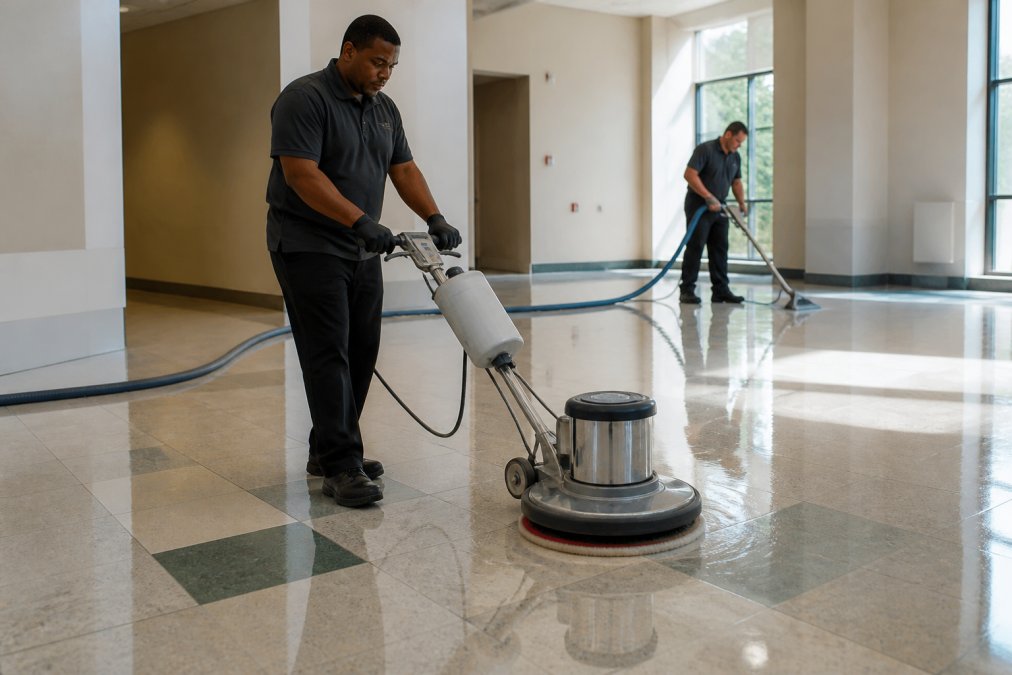
Propane Buffing and Carpet Cleaning for Lowcountry Facilities
High-traffic lobbies, hallways, and retail floors take a beating. Propane buffing restores shine and extends the life of VCT, while hot-water extraction pulls embedded soil from carpet. These aren’t tasks you hand to a generalist with a mop. They need dedicated equipment and a trained operator, which is exactly what a specialized provider brings.
Post-Construction Cleanup Services for Property Transitions
Post-construction cleanup services handle the fine dust, debris, and residue that general cleaning crews miss. After a build-out or renovation, fine drywall dust settles on every surface, including vents and light fixtures.
A proper post-construction clean covers:
- Removal of construction debris and packaging
- Fine dust removal from vents, sills, and fixtures
- Floor scrubbing and finish restoration
- Window, frame, and glass detailing
- Final walkthrough before occupancy
Hybrid Staffing Models: Combining In-House and Contracted Cleaners
Hybrid staffing models give facility managers the best of both. Keep a small in-house crew for daily touchpoints, and contract specialized or overflow work. This is the middle ground most guides ignore, they frame the choice as either hire full-time or outsource everything, when the practical answer for many facilities is a core team plus on-demand support.
What a Hybrid Model Actually Looks Like
A typical hybrid structure has three layers:
- Core in-house team, a small crew handling daily restroom, breakroom, and lobby service on your schedule.
- Contracted specialist, a janitorial provider handling periodic floor care, deep cleaning, and post-construction cleanup with commercial equipment.
- On-demand overflow, additional labor for seasonal spikes, move-ins, or one-time events, sourced through your contracted provider rather than individual gig workers.
This approach works well when you need daily restroom and breakroom service but only periodic floor care. It also smooths seasonal spikes, schools in summer, medical offices after a renovation, retail spaces before a grand opening. Many property managers across the Charleston area use a hybrid model to cover multiple buildings without hiring a full team for each one.
Quality Control Without Direct Oversight
The hardest part of any non-employee model is maintaining service standards when you’re not the one managing the crew. The fix is to build quality control into the contract rather than relying on goodwill.
Mechanisms that work:
- Written scope of work, list every task, frequency, and surface type so there’s no ambiguity about what “clean” means.
- Service level agreement (SLA), define response times, coverage windows, and remedies if standards slip.
- Inspection checklists, require the provider to document completion with photos or signed checklists, especially for floor care and post-construction work.
- Scheduled walkthroughs, a monthly or quarterly joint inspection catches drift before it becomes a complaint.
- Single point of contact, one account manager who owns escalations, so you’re not chasing a rotating crew.
- Backup coverage clause, confirm in writing how the provider covers callouts, holidays, and emergencies.
Track which tasks are truly daily versus periodic before choosing a model. Most facilities find that only a fraction of cleaning work actually needs to happen every day, and that fraction is what belongs in-house.
Where Hybrid Beats Both Extremes
A pure in-house model is expensive and inflexible for periodic work. A pure outsourcing model can feel distant for daily touchpoints. Hybrid lets you keep direct control over the visible, high-frequency tasks while pushing specialized and variable work to a provider who already owns the equipment and the trained operators.
A Simple Decision Rule
If a task happens daily, on your schedule, under your direction, and requires no specialized equipment, it can justify in-house staff. If it’s periodic, seasonal, equipment-intensive, or tied to a transition like a build-out or renovation, it belongs with a contracted provider. Most facilities end up with a mix, and that mix is the hybrid model.
How to Choose the Right Alternative for Your Charleston Facility
Choosing the right alternative starts with matching the model to your property type and budget.
- Single small office: Contracted service, weekly or biweekly.
- Medical or school facility: Contracted service with strict hygiene protocols and documented quality checks.
- Multi-property portfolio: Hybrid model or a single turnkey provider across all sites.
- Post-construction or transition: One-time specialized cleanup before occupancy.
Questions to Ask Before You Sign a Contract
- Who is your direct point of contact when something goes wrong?
- How do you document quality and proof of service?
- What’s your process for covering callouts and emergencies?
- Do you handle specialized floor care in-house or subcontract it?
- Can you scale coverage across multiple properties?
Heavenly Touch Janitorial Services, LLC answers these with over 20 years of experience, comprehensive floor care including propane buffing and VCT maintenance, and turnkey service for property transitions. Pricing depends on your facility size, surface mix, and service frequency, so request a free estimate for exact numbers.
Frequently Asked Questions
What are the primary benefits of outsourcing commercial cleaning services?
Outsourcing gives you access to trained crews, commercial-grade equipment, and specialized skills like propane buffing and VCT maintenance without the overhead of payroll taxes, benefits, and workers’ compensation. You also get coverage during sick days and vacations, consistent quality through contract accountability, and the flexibility to scale services up or down as your facility’s needs change.
How does a professional janitorial service compare to hiring an in-house cleaner?
A professional janitorial service provides a team with specialized training, commercial equipment, and backup coverage. An in-house cleaner is one person you must manage, insure, and cover during absences. For most Charleston facilities, the total cost of a full-time employee, including benefits and taxes, often exceeds a contracted service that delivers more consistent results and specialized floor care.
Are there cost-effective alternatives to full-time janitorial staff for small businesses?
Yes. Many small businesses use scheduled contract cleaning for routine tasks and on-demand deep cleaning for seasonal or event-based needs. This approach avoids the fixed costs of a full-time hire while still maintaining a clean, professional space. You can also request a customized turnkey solution that bundles floor care, restroom sanitation, and post-construction cleanup into one service agreement.
What is the difference between general janitorial services and specialized floor care?
General janitorial services cover daily tasks like trash removal, vacuuming, restroom cleaning, and dusting. Specialized floor care focuses on maintaining hard surfaces such as VCT, tile, and concrete through stripping, waxing, propane buffing, and carpet extraction. Facilities with high-traffic floors often need both, and a turnkey provider can handle all of it under one contract.
How do turnkey cleaning solutions improve facility maintenance efficiency?
Turnkey solutions consolidate all cleaning tasks under one provider, so you have one point of contact, one invoice, and one standard of quality. This reduces administrative time, eliminates gaps between vendors, and ensures floor care, post-construction cleanup, and routine janitorial work are scheduled without overlap. For property managers overseeing multiple Charleston-area sites, turnkey service simplifies coordination and improves consistency.